
Note: The following are copies of email communications from LCCEA President Adrienne Mitchell and LCCEA Officers to Lane Board Chair Mullholland and the Board sent on September 29, 2024 and September 3, 2024.
Chair Mullholland and Esteemed Board members,
I am writing to let you know as a courtesy that LCCEA had to file another unfair labor practice complaint last week regarding two issues.
One of the unfair labor practice issues is about LCC’s refusal to bargain over impacts of changes to minimum qualifications in the ABSE and ESL departments. These changes affect mandatory subjects of bargaining, which means that LCC is legally obligated to negotiate over the impacts. After four and a half months seeking information, requesting collaborative meetings, and proposing solutions and making settlement offers, LCCEA has not yet been able to receive clear, definitive responses, nor have we received any counter offers or settlement proposals from LCC. To date, LCC has agreed to only one meeting, which included minimal discussion of the substantive issues. (As reported previously, there are also separate issues related to compensation for required training affecting faculty in ABSE and ESL, which are scheduled for an arbitration hearing (i.e., a hearing to adjudicate an alleged contract violation).)
The second unfair labor practice issue is related to email communication sent from management directly to faculty members containing inaccurate information, false allegations, and admonishing LCCEA for engaging in protected union activity advocating on behalf of faculty members, which the union is legally obligated to do and which LCCEA has done at the express request of affected faculty members who were rightfully concerned about their job security.
This takes place against a backdrop of broader concerns where the May 2024 Gallup campus climate survey of all LCC employees results indicate that LCC ranks in only the 5th percentile nationwide on the question, “If I raised a concern about ethics and integrity, I am confident my employer would do what is right” and the 8th percentile on the question, “Everyone at this institution is treated fairly regardless of individual differences, such as ethnic background, race, age, disability, sexual orientation, gender or gender identity.”
The second unfair labor practice issue is precisely what our officers were concerned about when we wrote to you all as our esteemed, publicly elected Board of Education in early September (below and attached) regarding the plans laid out in the LCC President’s goals that the Board has now approved. In that letter, we expressed strong support for the overall goal of improving labor relations but also shared concerns that the steps outlined to achieve that goal would be divisive, would negatively impact campus climate, and would likely lead to further unlawful activity by LCC.
We were disappointed to see this concern come to fruition with a new unfair labor practice by LCC less than two weeks after the Board voted on the goals.
We remain concerned about substantial state funding & student tuition dollars being expended on outside attorneys by LCC due to ongoing unfair labor practice activity and other increasing legal fees LCC is paying. This is not what faculty want for our campus or our community.
We will continue advocating for collaborative labor relations. This is not something LCCEA representatives can accomplish on our own — it’s necessary for LCC to become a willing partner in that collaboration.
We do deeply appreciate your support as the Board for improving labor relations as a goal. We continue to recommend the strategies outlined in our message (below) on September 3 to you all as productive, lawful ways to improve labor relations, which must include working directly with and collaborating directly with union representatives. We seek your leadership to provide the much needed direction for LCC to prioritize collaboration, to seek resolution to issues at the lowest level possible, and to actively participate in the steps required to achieve collaborative resolutions.
As always, thank you for your dedicated volunteer service on the Board and to the people of Lane County.
Sincerely,
Adrienne
Chair Mulholland and Board of Education Members,
Please find below and attached a message from the LCCEA faculty along with two appendices. We ask that you kindly forward this to Board member Wiseman, whom we look forward to welcoming but who does not yet have email contact information posted on BoardDocs. Thank you.
September 3, 2024
Esteemed Board of Education Members,
As we close out the Labor Day weekend with appreciation for our members’ advocacy for and dedication to our students, our faculty from historically oppressed groups, our community, and our broader democracy, we look forward to a new academic year with better learning and working conditions on campus.
We are writing on behalf of faculty to express our support for improving labor relations, which sadly have deteriorated dramatically and rapidly over recent years, at our beloved Lane Community College.
For instance, during the 23-24 academic year, LCCEF classified professionals nearly went on strike after mediation stagnated when LCCEF had not gone to mediation over bargaining for approximately 10 years. During the same year numerous unfair labor practice charges were filed by LCCEA due to LCC retaliation against faculty union members and representatives; direct dealing by LCC with faculty members; and unlawful interference by LCC with the union, which went to a four-day hearing in May after more than two decades without a single unfair labor practice hearing. (See also the appendices.)
We are heartened that the LCC President’s draft goals include improving labor relations.
However, we are deeply concerned that the steps outlined to foster positive labor relations will not only contribute to further deterioration of labor relations and increased conflict (and likely continued escalating legal fees incurred by LCC), the steps and metrics outlined in the draft goals will most likely also result in additional unfair labor practices by LCC.
We ask for your leadership and direction to change this course.
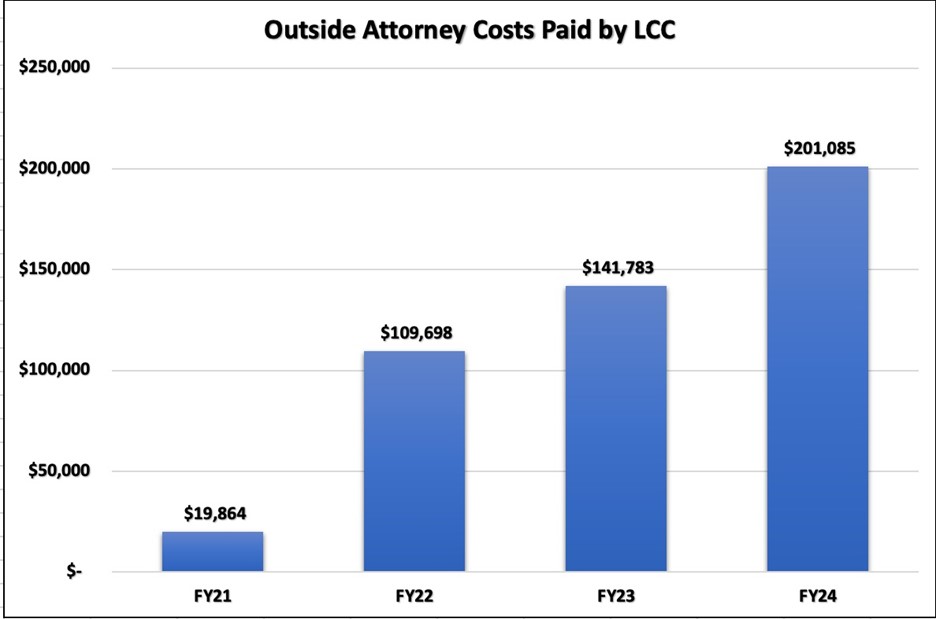
The facts illustrate the significant increase in labor strife as well as the dramatically increasing amounts that LCC is spending on outside attorneys for faculty labor disputes*. (*No data is publicly available on outside attorneys for other issues.)
As you will see on the chart below, the amount that LCC has paid to attorneys for labor disputes with faculty has increased tenfold since FY21. (Data Source: Information provided directly to LCCEA by LCC Administration and HR). These are precious taxpayer and student tuition dollars that could be devoted to the college mission rather than legal fees.
In addition, LCC has been represented by at least five different attorneys over this time period, including at least one who declined to continue representing LCC after their experience working with the college representatives. Currently, LCC is represented by an attorney based in the state of Wisconsin. All these factors contribute to instability in labor relations, rather than collaboration and productive resolutions.
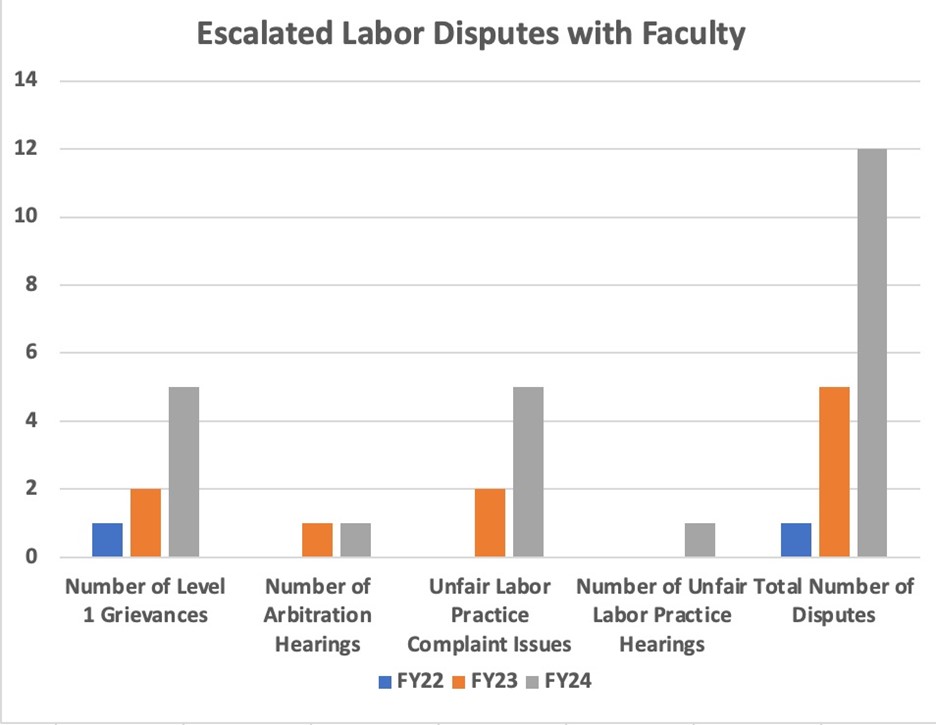
In addition, the number of issues that have escalated to level one grievances (i.e., formal contractual violations), unfair labor practice complaints filed with the state, and/or arbitration or other hearings have also increased dramatically from one in 21-22 to twelve in 23-24.
| Escalated Labor Disputes with Faculty | |
| Year | Total Number of Disputes |
| FY22 | 1 |
| FY23 | 5 |
| FY24 | 12 |
Please note that over these years, the number of informal level issues that have arisen has remained roughly the same. Likewise, the leadership of LCCEA and teams working on these issues have remained the same as has our goal of proactively preventing issues from happening and productively and collaboratively resolving issues at the lowest level when they do occur. We have experienced a marked difference in the management approach, which has led to fewer meetings and discussions, far fewer issues resolved at the informal level, and ultimately increased escalation and legal fees that the College must bear. Every hearing over this time period has resulted in a favorable outcome for LCCEA, further underscoring the need for collaborative problem solving and a management commitment to resolve issues at the lowest level.
Steps to improve labor relations should necessarily include working collaboratively and directly with the unions. Circumventing the unions to engage the “college community” in discussions and “dialogue” about labor relations through “meetings,” “surveys,” and “monthly updates” is not only counter-productive and divisive, it is likely to be found unlawful under Oregon’s Public Employees Collective Bargaining Act.
We ask you, the members of the Board of Education, to allow for more time to amend the goals and to provide leadership to encourage collaboration and dispute resolution at the lowest levels.
We recommend the following as steps and metrics for improving labor – management relations.
- President should commit to provide leadership to administrators and managers, setting the expectation and directive for management to (1) collaborate with the unions; (2) to work productively to seek to resolve issues at the lowest level possible; and (3) to follow all legal obligations, including but not limited to: providing notice to the unions whenever there is a change that could impact employee working conditions, meeting to bargain in good faith, meeting to resolve contract issues (i.e., grievances), etc. Evidence could include memos to management staff documenting the new expectation for collaboration.
- Decreased legal costs incurred by LCC with evidence including regular updates on legal bills
- Reduced litigation; significantly reduced number of issues going to arbitration or other hearing(s)
- Required regular training for managers and administrators on state labor law and immediate discontinuation of all unfair labor practices
- Required, jointly union-management developed and provided training to managers on the contracts
As leaders for the faculty, we are deeply committed to productive labor relations. Productive labor relations are also positive for our campus, our students, and our community.
Productive labor relations also require a demonstrated commitment from management and your explicit direction and guidance to set the tone and expectations. In short, we need a willing partner.
As the supreme governing body at Lane Community College, elected to represent the people of Lane County, voters and community members are counting on you as our Board members to provide direction to the President and to the entire campus and to create the college our community deserves.
While unions enjoy near highest public approval ratings since the 1960 according to a recent Gallup poll and new unions in higher education have surged tremendously, the timing could not be more apropos for you to provide leadership and direction with a renewed focus on better labor relations.
Thank you for your consideration and for your service on the Board.
Most sincerely,
LCCEA Officers, representing the part-time and full-time faculty of Lane Community College
Adrienne Mitchell, LCCEA President
April Myler, LCCEA Secretary
Wendy Rawlinson, LCCEA Treasurer
Wendy Simmons, LCCEA VIce President At-Large
Christina Howard, LCCEA Vice President for Career Technical Faculty
Rosa Lopez, LCCEA Vice President for Learning Advancement
Peggy Oberstaller, LCCEA Vice President for Part-time Faculty
Kate Sullivan, LCCEA Vice President for Transfer Faculty
and
Ken Volante, OEA Representative


 Lane Community College Education Association
Pingback: LCCEA President’s Update June 11, 2025 | Lane Community College Education Association
Pingback: LCCEA President’s 3/17/25 Update for LCC Faculty* | Lane Community College Education Association