LCC Faculty Colleagues,
(Abbreviated copy)
LCC Faculty Colleagues,
I hope this email finds you well as we approach the end of Winter term. Please find below an abbreviated version of my update.
I’m writing with updates from LCCEA, our faculty union, to address topics including upcoming bargaining, action and organizing, LCCEA committee leadership, the Board of Education, non-teaching work, Oregon residency, a new CAR user agreement, LMS advisory team, dispute resolution procedures, statewide events and legislative updates, and other news. These updates are organized by category with local updates followed by statewide and national.
Local Updates
Expanding Leadership in Our Union
As our union engagement continues to grow with more than 75 faculty members serving on LCCEA committees, teams, and roles, several of our LCCEA committees are transitioning to new leadership beginning in Spring. Aryn Bartley is the incoming Membership Chair; Wendy Rose Aaron and Jessica Alvarado are the incoming Racial Equity and Social Justice Co-Chairs; Joseph Colton is the incoming Grievance Chair, and Rosa Lopez is the new Legislative and Political Action Chair. Please welcome our new leads and join me in extending deep appreciation for Wendy Simmons and Christina Howard for their many years of dedicated leadership on Membership and Grievance committees respectively.
Bargaining
Your LCCEA Bargaining Team members are: Gerry Meenaghan, April Myler, Peggy Oberstaller, Russell Shitabata, and myself. We’ve been deep in our work this term preparing for negotiations with the College, which are scheduled to officially begin in April.
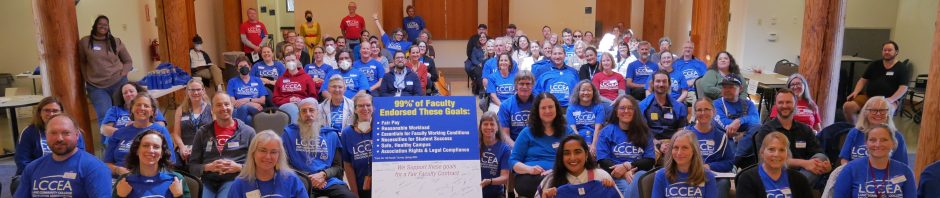
Thank you to all the hundreds of faculty who have participated in faculty forums, department rep meetings, faculty surveys, student listening sessions, that contributed to the development of our collective goals. which are based on well-documented faculty needs.
The development of these themes culminated in a vote last Spring when 99% of 215 faculty respondents said “yes” to endorse these goals – a show of extraordinary solidarity among faculty at large. Please stay tuned for more information and updates about bargaining throughout Spring term.
LCCEA 50th Anniversary Party
On Thursday, April 10th, we will celebrate 50 years of accomplishments by faculty for faculty with a party hosted by the Membership Committee from 5:30 – 7:30 p.m. at the Campbell Community Center’s Great Hall, 155 High St, Eugene, OR 97401. All faculty are most cordially invited. We’ll make toasts, eat cake, and have a 70s-style dance party! Dinner will be provided, and families are welcome. Come celebrate as we prepare for the next 50 years of member organizing power! Please RSVP.
Action & Organizing
Chaired by the amazing Wendy Simmons, Your LCCEA Action Team has grown to fourteen faculty members and has been busy coordinating successful events to support faculty goals in bargaining and advocate for our collective interests. Already, over the last year and a half, 114 faculty members have provided public comment at Board of Education meetings. Most recently, the Team:
- Hosted a rally with more than 50 faculty attending, plus several groups such as the Student Government Association, Graduate Teaching Fellows Federation, United Academics of UO and more in attendance; and
- Delivered a six-foot poster to the Board of Education with more than 100 faculty signatures supporting the bargaining themes.
Together, we will center the common good and create the campus our community deserves.
LCC Board of Education
LCC’s seven member Board of Education is the publicly elected governing body for LCC that makes critical decisions such as approval of the annual budget, ratification of union contracts, new program approvals, or budget cuts.
Board Candidate Endorsements
Members of your LCCEA Legislative and Political Action Committee and OEA PAC donors have interviewed candidates seeking our endorsement for the Board of Education. LCCEA proudly endorses pro-public education and pro-labor candidates Austin Folnagy, Devon Lawson, and Jesse Maldonado for LCC Board.
Board of Ed Vacancy
When Board member Lisa Fragala resigned after being elected to the state legislature, one seat became vacant. After putting out a public call to the entire county in November, the remaining six Board of Ed members called two special meetings in December and interviewed four highly qualified candidates to fill the vacancy.
However, after adopting a ranked choice voting method to select the candidate to appoint, three Board members either declined to vote for any candidates at all (Weismann) or declined to provide rankings for anyone other than their top choice (Mital and Alltucker). The three other Board members (Folnagy, Diamond, and Mullholland) adhered to the Board’s approved ranked choice voting process and sought to find a consensus in order to fill the vacancy. However, since Board action requires four votes, the Board did not appoint any candidate, and it has become more challenging for the Board to function and to take collective action on any decision before them with only six members.
In addition, the process was marked by actions and statements that appear to challenge democracy, including one Board member’s assertion that the Board members do not represent the people of Lane County (who elect them) and the revelation that the College President invited all the candidates to private meetings before the Board held their public interviews and public deliberation as required by Oregon’s open meetings law.
You can learn more about this unsuccessful process to fill the vacancy in media coverage in the Eugene Weekly, KLCC, the student LCC Torch Newspaper, and even a resolution by the Democratic Party of Lane County.
Limitations on Public Comment to Board of Education Proposed
More recently, the Board of Education has posted their agenda for this Wednesday’s work session, which includes consideration of procedures that would create new limitations on public comment , which is the only opportunity for campus and community members to address the governing body of our institution. Public comment is an essential component that allows the Board to hear from the broader community and fulfill its duty as democratically elected public officials.
Fortunately, Board of Education elections are coming soon. Watch your mailbox for ballots from Lane County Elections in May.
Hot Topics for Our Local
CAR user agreement for recordings
Your union leaders and the administration reached an agreement on a new CAR User Agreement. Students who have an accommodation to record classes will have to sign this new user agreement. It limits the use of the recordings to student personal study in alignment with the purpose of the accommodation and disallows release and posting of the recordings. We will be working collaboratively with HR on a similar agreement for employee accommodations.
Learning Management System Advisory Taskforce
The LMS Advisory Taskforce is meeting and working to ensure ample time for faculty to learn about options for the Learning Management System (e.g., Canvas, Moodle). Please look for opportunities through May 2 to attend demonstrations and provide feedback on the options through surveys. Thank you to Jason Ambacher, Wendy Lightheart, Erika Masaki, Rick Riordan, and Michael Woods, who are the LCCEA appointees. Find details on upcoming demos and recordings from recent ones on the ATC website.
Labor Relations & Dispute Resolution Procedures
ABSE and ESL
As you may recall, there are numerous issues impacting the job security of the 40+ faculty working in ABSE and ESL. Please extend your commendation and appreciation to our faculty colleagues in ABSE for superlative solidarity and their impactful efforts in participating in a two-day arbitration hearing in February where all the full-time faculty and one part-time faculty stood together and spoke the truth in an effort to find justice for all affected faculty in the ABSE department. Additional dispute resolution procedures are scheduled for the upcoming months to address the remaining issues affecting both of these two departments.
LCC Engaged in Unfair Labor Practices – Recommended Order Issued
An Administrative Law Judge at the Employment Relations Board issued a recommended order finding that LCC engaged in several unfair labor practices by violating the PECBA (i.e. the Public Employees Collective Bargaining Act) – the state law that protects the rights of public employees to bargain collectively and to engage in union activities. Specifically, the recommended order found that LCC violated four subsections of ORS 243.672 – (1)(a)(b)(c) and (e). More information will be available once the final order is issued. (See the appendix for details on the relevant statute.)
Advocacy for Collaborative Labor Relations
Your LCCEA leaders continue to advocate for resolutions to contractual disputes (i.e., grievances) and legal issues (i.e., unfair labor practices) at the lowest level possible. We have been disappointed that our current Administration has not demonstrated a willingness to reach reasonable settlements or, in some cases, even meet to discuss possible solutions. Your LCCEA officers have engaged in ongoing advocacy with the Board of Education about this over the course of several months after seeing a dramatic increase in issues that remain unresolved where the Administration has demonstrated a preference for litigation over collaborative resolution.
To give a sense of the scope of this change, during my first several years as LCCEA President, we had zero issues that could not be resolved through mutual agreement between the Administration and faculty representatives and that went to any type of hearing. In 2022, there was one hearing to resolve a labor dispute; in 23-24 there were two hearings; and in 24-25 there are four hearings scheduled. During this same time period over the past two and a half years or so, the Administration has had seven different attorneys representing them, frequently staying to litigate one issue or for a short period of time, then no longer working with LCC after that. Most recently, an attorney from Wisconsin who is not admitted to the Oregon Bar represented LCC in an arbitration in February, traveling to Oregon for the hearing – something that is unheard of in the public sector in Oregon. The legal costs to LCC have also escalated dramatically – amounting to nearly half a million dollars from 2022 through June 2024.
We find this to be a misuse of public funding.
Thus far, our calls for collaboration instead of litigation have not resulted in any public action by the Board of Education. The College President has not expressed a willingness to direct administrators to seek resolutions, nor has the LCC President responded to our reasonable requests to even attempt to avoid litigation.
We do not think this is healthy or productive for our campus or our community and will continue to advocate for a reasonable, collaborative approach to labor relations. Our campus and our community deserve better.
We call on the Board of Education to take action to direct the Administration to collaborate and seek resolutions, to avoid litigation, and to redirect resources to supporting the college mission.
Statewide Updates
OEA Representative Assembly
Congratulations to our delegates elected to represent LCCEA at the Oregon Education Association Representative Assembly in April: Don Easton, Cybele Higgins, April Myler, and Meggie Wright. I will be serving as an LCCEA representative as well. Alongside 700+ OEA member delegates from throughout Oregon, we will participate in a democratic voting process to guide the work of the OEA for the next year, including legislative objectives and election of statewide leaders. We are excited about what’s to come for OEA as our statewide organization continues to grow, especially for our community college council with more unions affiliating, to build a stronger member-led, dynamic, vibrant future.
Statewide Labor Landscape
Contract negotiations at many educational institutions are heating up.
Most pressing among them, the United Academics, the faculty at UO, have voted overwhelmingly to strike if they do not reach an agreement with the Administration at UO. The strike could begin as soon as March 31, the first day of Spring term. Let’s stand together in solidarity with our UO faculty colleagues and support them! It’s important to recognize that the UO may be looking for instructors to teach classes in the event of a strike, and accepting such teaching assignments amounts to crossing the picket line. Let’s continue to show our strong support for United Academics at UO by honoring their request that LCC faculty not accept any such teaching at UO.
This pattern is visible throughout the state. Albany teachers were on strike in November. The classified staff at Mt. Hood Community College recently reached an impasse (i.e., the last step before a strike) and then achieved a tentative agreement shortly thereafter. (See the timeline for bargaining for public employee unions here). Chemeketa Community College faculty are attending strike school as they continue in mediation and prepare for a possible impasse.
Legislative Updates
Governor’s Budget for Community Colleges
Governor Kotek recommended an allocation of $870.4M for the CCSF (i.e., community college support fund – state funding for community colleges), which is a 6.9% increase from this biennium. The next step will be for the Joint Ways and Means Committee to finalize the allocation during Oregon’s long legislative session which continues through June. The Governor’s budget is typically a floor from which the allocation increases, so we will continue advocating for a more substantial increase for our community colleges!
Legislative Advocacy and Opportunities
Our LCCEA Legislative Chair, Rosa Lopez, and numerous faculty are heavily engaged in lobbying during Oregon’s current long legislative session. At least ten faculty from LCCEA have provided testimony on bills that impact our work and our students, including supporting pay parity for part-time faculty, opposing unsafe nursing clinical ratios, and supporting increased funding for: community colleges, the Oregon Opportunity Grant (needs based funding for students) and basic needs navigators.
Learn more about upcoming opportunities such as the Ways and Means Roadshow where our state lawmakers responsible for developing Oregon’s budget will tour the state to hear from the people or take a minute to send a message to legislators in support of pay parity for part-time faculty.
National Landscape
As we navigate the ever changing political landscape at the national level, LCCEA has added a new page to our website to provide more information about immigrant and LGBTQI+ rights. The page includes links such as LCC’s Sanctuary Campus resolution, Oregon Department of Justice Sanctuary Promise website, and resources from our national union, the NEA. Please do not hesitate to reach out with suggestions for additions to the new resource page on our LCCEA website by contacting any LCCEA officer or Comms Chair, Anne McGrail.
A recent all campus communication suggested that employees with concerns about their own immigration status contact HR or their manager. However, please note: we do not recommend that any faculty member with such concerns contact HR or their manager. In fact, we recommend that you take no such action. You may reach out to LCCEA representatives for a confidential consultation. In addition, please rest assured that any LCCEA member who faces any legal issue while at work is eligible for support through the OEA/NEA legal defense fund, which could occur if, for instance, any faculty member is impacted by an encounter with ICE on campus.
Together with our labor and higher ed partners in Oregon and throughout the state, we are monitoring changes coming about through the US national government and taking action to protect public education including employees, our students, and our communities.
National Day of Action
On April 17, we will participate again this year in a National Day of Action for Higher Ed in collaboration with student leaders at LCC and coordination with organizations throughout the US. Save the date and please stay tuned for more information on how you and your students can participate to effect change on campus, in our state, and nationally.
In Closing
Despite all the tumult at the national level, I am heartened by our extraordinary member solidarity and inspired by our collective focus on the common good. Together, we are stronger.
At a time when public service is under tremendous fire at the national level, being an active union member is not only about supporting our contract campaign for our wages and benefits, it is about supporting the conditions that allow us to do our best work in service of our students and communities. And importantly, it is about ensuring that public institutions and critical services have sufficient funding to meet community needs. And that our public institutions not only survive, but thrive.
As public employees we contribute to the public good. We are the teachers, the public health nurses, the firefighters, the social workers, and the community college faculty who serve our communities. We work every day to support our community college mission of access and equity. We teach our students to think critically and to develop career skills to achieve a better future for themselves and for their families. We provide an opportunity for higher education and economic mobility that would not be possible without public community colleges.
Our higher education institutions stand on the bedrock of academic freedom and freedom of expression, which are increasingly challenged in this new national landscape. Now and going forward, let us remember the critical, foundational role of higher education, particularly our community colleges in a healthy, vibrant democracy.
Our students and our communities depend on us. Our union helps ensure that we remain here to serve them.
And we are not alone. We are part of the labor movement that is very part of the fabric of our nation. We stand shoulder to shoulder with our labor partners and community organizations in solidarity to uphold our most precious gem, our democracy.
Most sincerely, and in solidarity,
Adrienne
Dates for your Calendar
Coffee & Donuts, April 2, 9:30 – 11, main campus & downtown campus, hosted by Membership Committee
RSVP for the LCCEA 50th Anniversary Party, April 10, 5:30 – 7:30 p.m, hosted by Membership Committee
National Day of Action for Higher Ed, April 17 – hosted by Action Team & Legislative Committee
Board of Ed meetings, April 2, May 7, June 4
Bargaining dates 1-4 on April 10, April 17, April 24, May 8, May 29 & June 5; 12-2 on May 23
Appendix
Unfair labor practices
An Administrative Law Judge at the Employment Relations Board issued a recommended order finding that LCC engaged in several unfair labor practices. The recommended order found that LCC violated four subsections of ORS 243.672 – (1)(a)(b)(c) and (e). More information will be available once the final order is issued. See the relevant statute below.
ORS 243.672 Unfair labor practices
It is an unfair labor practice for a public employer or its designated representative to do any of the following:
- Interfere with, restrain or coerce employees in or because of the exercise of rights guaranteed in ORS 243.662 (Rights of public employees to join labor organizations).
- Dominate, interfere with or assist in the formation, existence or administration of any employee organization.
- Discriminate in regard to hiring, tenure or any terms or condition of employment for the purpose of encouraging or discouraging membership in an employee organization. Nothing in this section is intended to prohibit the entering into of a fair-share agreement between a public employer and the exclusive bargaining representative of its employees. If a “fair-share” agreement has been agreed to by the public employer and exclusive representative, nothing prohibits the deduction of the payment-in-lieu-of-dues from the salaries or wages of the employees.
- …
- Refuse to bargain collectively in good faith with the exclusive representative.


 Lane Community College Education Association