Memo to LCC Board of Education

Esteemed Board of Education members,

I am writing with a few critical updates for your consideration. I ask that you uphold your roles and duties as publicly elected Board of Education members in voting per your own policies and in ensuring that the LCC Administration follows your direction and takes action consistent with your votes. The people of Lane County are counting on you to fulfill your democratic function as elected Board members governing our beloved LCC.

  1. The LCC Administration continues to present the idea in multiple meetings across campus that the LCC Board has approved or accepted cuts of $3M each year for the next three years. As you may be aware, the budget development process for next year has not yet begun, and this action appearsinconsistent with Oregon Public Budget law according to a legal memo and your own votes as the Board of Education. In addition, the Board voted on September 30, 2025 to explicitly exclude the $3M reference from the President’s goals.

See examples of direct quotes from management to faculty this week. In addition, I personally attended the College Council meeting last week where the Administration again presented to the full Council and numerous deans in attendance that the Board had accepted a plan to make $3M in cuts each year for the next three years.

Direct quotes from deans by email to faculty in their areas over the past few days:

“the planned $3 million in cuts starting in FY27 through FY29, which have been discussed at multiple board meetings and our Fall In-Service.”

“As part of the ____ Division’s 7% reduction to the part-time faculty budget…”

“As you may already know from various forums and sources, the college is projecting deficits for the current year and the subsequent two years. In order to begin to close these deficits and to begin to raise the ending fund balance to 10% per the Board of Education’s policy we are having to reduce the current year’s part time assignments for winter and spring terms. These adjustments are occurring across Academic Affairs. “

  1. The LCC Administration is directing deans to cut 7% from part-time faculty budgets across the college this year. Deans are cutting classes that students have already begun registering for from the Winter and Spring term schedules.  This year’s budget does not have 7% cuts in the part-time budget – this has not been presented nor approved by the Board of Education.  According to the Budget and Finance office, the amount built into this year’s budget for part-time faculty is $8,614,774, not including OPE. OPE adds an additional $2.M, bringing the total part-time budget to $11,543,797. Cutting this budget by 7% amounts to $808,066. This figure far exceeds the $675,000 in budget reductions that the Board approved and far exceeds the $262,500 figure presented by the Administration as a proposed plan at the September 3 Board of Education meeting, which the Board has also not voted to approve.

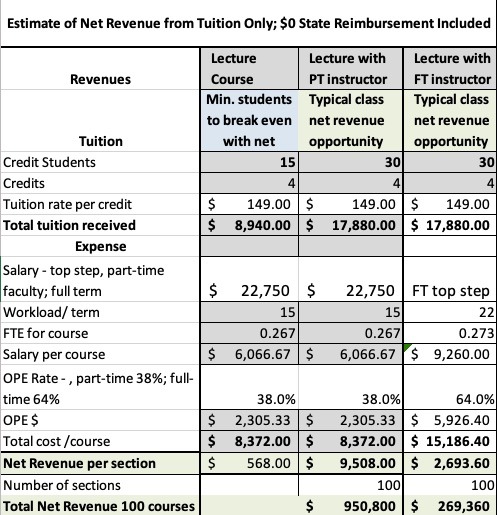
  2. Cutting lecture classes, which generate substantial net revenue on tuition alone without any state reimbursement, will not only remove opportunities for students, it hurts the bottom line. LCC will lose money and close the door to students. See below for details. A lecture class with only 15 students taught by a top-paid part-time faculty member generates net revenue. A single lecture class with 30 students generates nearly $10,000 in net revenue (after subtracting full salary and full OPE overhead costs). 100 sections generate nearly $1,000,000. A similar course taught by a full-time instructor at the top of the salary schedule generates $2700 in net revenue and $269,360 for 100 sections. Please note: these revenues are generated based on tuition alone, so state funding is excluded from these calculations, and the growth cap in the CCSF does not apply.
  1. LCCEA has demanded to bargain over the sudden cuts to part-time faculty, for which LCCEA has received no notice from the Administration. LCC is legally obligated to refrain from cutting these classes and negotiate with LCC. The LCC Administration has not responded to LCCEA’s demand to bargain. If the Administration continues cutting these classes from the Winter and Spring schedules prior to negotiating with the faculty, that action constitutes another unfair labor practice under Oregon state law.
  1. Finally, regarding the important goal of maintaining a 10% ending fund balance. Please note that BP 6230 requires, “When the Ending Fund Balance falls to 9% or less, the college shall adopt a plan to replenish the Ending Fund Balance to 10% within three years.” The FY24 Ending Fund balance according to the most recent official audit statement is $8,332,887, and LCC Administration estimates that the FY25 ending fund balance is $8,570,000. This ending fund balance has grown by $1M over two years. This means that the restoration which should occur over the next three years should amount to about $800,000 per year, not $3M per year. The policy requires restoration of the actual ending fund balance, not future projections that build in unrealistic assumptions such as 7.5% salary increases and 19% OPE increases.

Thank you for your service on the LCC Board of Education.

Your role is vitally important for our democracy, including responsibility and accountability to the people of Lane County.

Most sincerely,

Adrienne

Posted in General | Tagged , , , , , | Leave a comment

Bargaining Update — Progress: Our Actions Can Make the Difference

LCC Faculty Colleagues –

Today we made some progress in bargaining. It is clear that the organizing activities like last week’s march, Board emails, Board speakers, and our robust voting campaign are having an impact. Let’s keep up our momentum! 

Today we proposed:

* updated language on privacy rights that brings us close to agreement on that issue (Art. 16);

* elimination of one additional MOA to meet College interests in simplifying the final contract (CBA Updates);

* updates on safety and working conditions in the event of a public health emergency that clarifies faculty interests and includes basic safety provisions such as remote meeting options and water and indoor safety standards that apply at all times (Art. 46); 

* updated language regarding a move to a new LMS (i.e., Canvas) that would provide reasonable time and compensation for the transition while lowering the total cost of our initial proposal (Art. 43); 

* a minor update to our proposal about new hire orientations to address College concerns (Art. 11); and

* a scaled back version of Art.9 that includes one non-instructional work day for Election Day in November for educational activities with no additional cost to the College.

The College proposed:

* to continue current language in Art. 1, withdrawing their proposal that contracted faculty who work 0.75 FTE would be considered part-time faculty; 

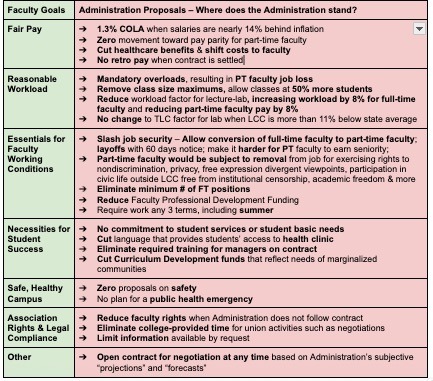
* one meaningful update to Art. 10 by withdrawing their proposal that would have allowed layoffs for the sole purpose of converting full-time faculty to part-time positions but NO update that restores part-time faculty protections against removal for exercising inherent rights (e.g. nondiscrimination, free speech, academic freedom, etc.);

* a proposal that would cut insurance benefits less than their previous proposal did, moving to Moda Plan 2 as the base plan, but also suspending important language that protects against large employee contributions for next year (Art. 33);

* a couple of updates that retain existing language on part-time faculty pay for specific committees and governance meetings and one incorporating a single provision from an existing ESL MOA (Art. 26, 34, governance article);

* a proposal to deduct contracted faculty dues over ten months instead of nine, resulting in lower deductions each month, but no response to our proposal to make similar changes for part-time faculty dues nor to pay part-time faculty for Fall term earlier than October 25 (Art. 31); and

* a slightly updated proposal allowing a faculty member to ask their dean to find a sub when ill (Art. 32).  

See links below for Oct 14 proposals and here all proposals.

Still, the Administration rejected all of our proposals on lockdown and public health safety, student needs (such as mental health clinicians and basic needs support), faculty essentials (such as office space, hardware/software to do our jobs, rights and protections around AI, ethical search processes) and many more.

Clearly, we still have a long way to go with significant outstanding issues including workload, compensation, class size, lab rates, and numerous others.

We will host informal Q & A session on Zoom, which is open to all faculty:

Friday, October 17, 1:30 – 2:00 Register here

The stakes remain high. Please be on the lookout for updates from your Department Reps and Action Team for more ways to participate and help shape bargaining in the coming days and weeks.

At this time, due to the Administration’s lack of availability, we won’t meet for bargaining again for nearly a month, and we only have the following four remaining dates scheduled. Please join us in building 2, room 214 for part or all of any session. 

  • Mon., Nov 10, 2-5 p.m.
  • Tues., Nov 18, 1-4 p.m.
  • Tues., Dec 2, 1-4 p.m.
  • Tues., Dec 16, 1-4 p.m.

Your LCCEA Bargaining Team Leads,

Gerry Meenaghan

Adrienne Mitchell

April Myler

Peggy Oberstaller

Ryan Olds

Russell Shitabata

PROPOSALS

Oct 14 LCCEA Proposals

Oct 14 Administration Proposals

Posted in General | Tagged , , , , | Leave a comment

Bargaining Update & New Zoom Q&A Sessions Scheduled

LCC Faculty Colleagues –

Today we made a little progress in bargaining. These were very small steps in the right direction. However, the vast majority of key issues important to faculty remain unaddressed.

Today we proposed:

* updated language on the nondiscrimination clause to adopt some of the language proposed by the college while still retaining important protections for multiple categories of faculty (Art. 7);

* updated curriculum development rate from $40.26 per hour (which would have recuperated all historic increases to catch up to inflation) to $36.72 per hour (which would recuperate inflation since 2022) (Art. 23);

* updated language that takes an incremental approach to ensuring sufficient staffing for student services such as mental health clinicians and child care slots available that reduces the immediate financial cost; (Art. 42); and

* updated proposal on Oregon residency to move toward the college while continuing to protect the small number of faculty who do live outside Oregon and to allow limited exemptions for future faculty (Art. 47). 

The College proposed:

* A minor update to Art. 41 to comply with the law; 

* A minor revision to their proposal on Oregon Residency changing only a few inconsequential words about notification (Art. 25);

* A revision to their proposal for Art. 2 that means the Administration is no longer seeking to eliminate past practice related to written agreements; 

* An updated proposal on privacy rights that makes meaningful progress to bring the parties closer together on this one issue (Art. 16); and

* An updated proposal on non-discrimination that adds ancestry, familial status, and union activity to the clause, but does NOT include protections for immigration status, medical conditions, reproductive decisions/status, caregiver status, height, and weight.

See below for all proposals. All proposals exchanged to date can be viewed on our Bargaining Proposals page here.

We will host informal Q & A sessions on Zoom, which are open to all faculty:

Friday, October 10, 10:00-10:30 Register here

Friday, October 17, 1:30 – 2:00 Register here

Thank you to everyone who made it to bargaining today, and a huge shout out to all who joined the solidarity march and rally on Saturday. We were 300+ faculty, students, OEA members, community and labor supporters strong, all marching together through downtown Eugene for a fair contract for our future and our democracy!

Nonetheless, the stakes remain high and we need to keep up our momentum. Please be on the look out for updates from the Action Team and your department reps for more ways to participate and help shape bargaining.

At this time, we only have the following five remaining dates scheduled for bargaining. Please join us in building 2, room 214 for part or all of any session. 

  • Tues., Oct 14, 1-4 p.m.
  • Mon., Nov 10, 2-5 p.m.
  • Tues., Nov 18, 1-4 p.m.
  • Tues., Dec 2, 1-4 p.m.
  • Tues., Dec 16, 1-4 p.m.

Your LCCEA Bargaining Team Leads,

Gerry Meenaghan

Adrienne Mitchell

April Myler

Peggy Oberstaller

Ryan Olds

Russell Shitabata

Oct 7 LCCEA Proposals

Oct 7 Administration Proposals

All Proposals

Posted in General | Tagged , , , , , | Leave a comment

Background Information about Budget Forecasts

Dearest Faculty Colleagues —

I’m writing to share some background information about the college budget forecasts that I have also provided to the Board of Education and a brief update. (See below.)

At last week’s all-campus inservice, the Administration announced that the Board of Education had approved a plan to reduce $3M from the budget each year for the next three years for a total of $9M.

However, this week at Tuesday’s Board of Education meeting, Board members confirmed that the Board had not voted on nor approved such a plan

On Tuesday, they did vote to remove the reference to $3M reductions for three years from their action item and continue the discussion in future months. Hence, despite reports at the all-campus inservice, the Board had not in the past, nor did they vote this week to approve $3M in cuts each year for the next three years.

Please find more details below as to why cuts should not be necessary. 

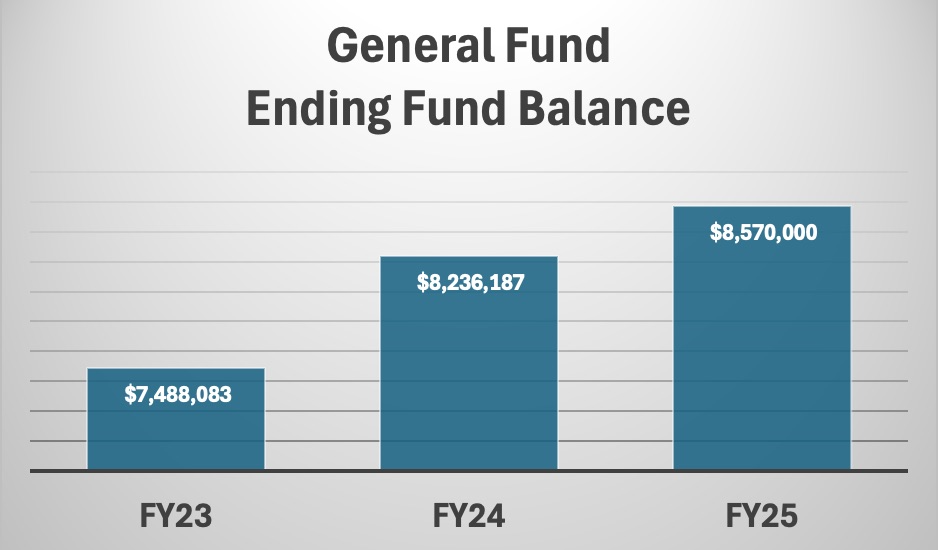
In brief, all three revenue sources for LCC are up — state funding, property taxes, and tuition revenue. Revenues exceed expenses, and the Ending Fund Balance (i.e., reserves in the general fund) is growing. It has increased by $1M to $8.6M in the past two years as the reserves continue on an upward trajectory and on track to meet the 10% Board policy requirement of approximately $10M for the general fund (i.e., 10%). (These reserves do not include multiple other funds with positive balances.) Cutting $3M per year for three years amounts to $9M, which is not justified by Board policy, nor has it been approved by the Board.

We are grateful the Board voted to postpone this line from their action item in order to allow more time to review the data, especially overinflated expense estimates which they questioned on Tuesday. This time will allow them to fulfill their responsibilities as publicly-elected Board members, to uphold their commitment to represent the people of Lane County, to make decisions in accordance with Oregon’s open meeting law and public budget law, and –as members of our institution’s highest governing body in accordance with state statute–oversee the Administration.

My best regards,

Adrienne

———- Forwarded message ———
From: Adrienne Mitchell <mitchella@lanecc.edu>
Date: Sun, Sep 28, 2025 at 8:09 PM
Subject: Background Information about Budget Forecasts
To: Austin Folnagy <folnagya@lanecc.edu>, <rustj@lanecc.edu>, Steve Mital <mitals@lanecc.edu>, <Weismannj@lanecc.edu>, Zach Mulholland <mulhollandz@lanecc.edu>, <alltuckerk@lanecc.edu>, <maldonadoj@lanecc.edu>

September 28, 2025

Esteemed Board of Education Members,

As promised, I am writing to share additional information with you.

LCC has three primary revenue sources: tuition, state funding, and property taxes – all of which are up and continue on an upward trajectory with revenue exceeding expenses.

This bears out in the growing reserves of the ending fund balance. The FY23 and FY24 figures come directly from the official audit statements linked, and the FY25 estimate was provided by the administrators of the Budget and Finance offices. These data from the external auditors and the Administration confirm that there is no structural deficit because revenues exceed expenses resulting in growth of reserves.

The budget development process for FY27 has not yet begun, nor have the steps that are required by Oregon Public budget law for FY27, let alone future years.

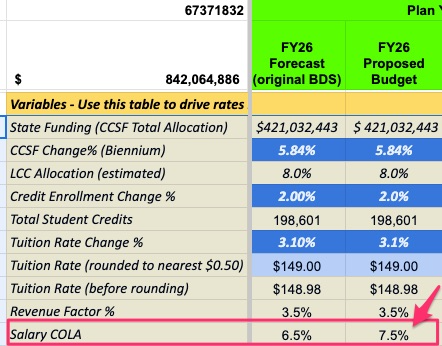
This year’s budget (i.e., FY26) had been balanced by the Budget Development Subcommittee and approved unanimously by the College Council, including students, stakeholders, and all top ranking administrators in voting positions. Even though it was approved unanimously, the Administration presented a different budget to the Board and its Budget Committee in May, making numerous changes, some of which are especially impactful in exaggerating expense estimates. For instance, the Administration changed the COLA (i.e., cost of living adjustment AKA salary schedule increase) built into the budget by increasing it from 6.5% to 7.5% for all employee groups, which added pressure to the budget and resulted in the call to cut $675,000 from the budget, which the Board did approve in June. You can see this increase in the Budget and Finance Office’s own forecasting model, a screenshot of which is below showing the change.

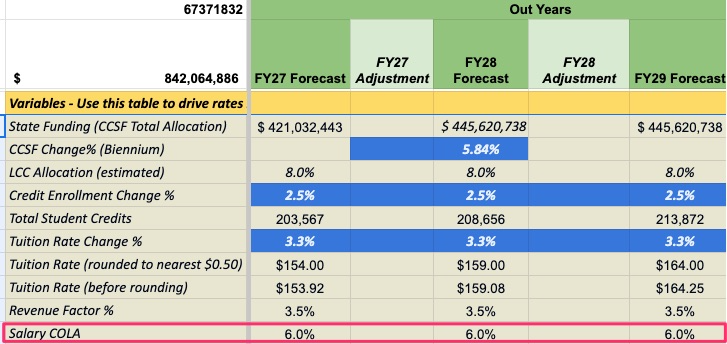
In addition, budget forecasts for multiple future years build substantial COLAs for all employee groups into each year. These compound to significantly overestimate future expenses. Please see below for another screenshot of the Administration’s own forecasting tool showing 6% COLAS built into each and every year for the next three years.

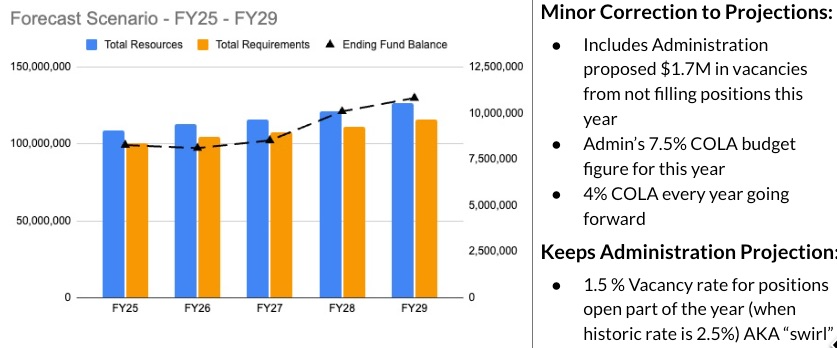
Please note that these COLA figures are merely one example of the assumptions that create an impression of future budget deficits. Other features built into the forecasts that contribute to exaggerated expenses include a vacancy rate set lower than the historic average, among others. It is the use of these unrealistic assumptions that create the forecast of decreasing ending fund balances (i.e. black dotted line), which you can see in the chart below from the Administration’s model.

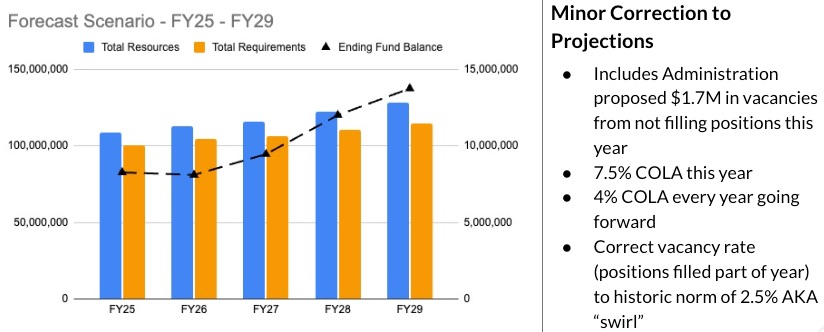
However, if one makes the most minimal adjustments such as including the $1.7M in vacancies the Administration stated on September 3 they will build into this year’ s budget and using 4% as a placeholder figure for COLAs for future years, even while maintaining the Administration’s 7.5% COLA figure for this year, the trajectory is positive, exceeding board policy requirements. Please see the chart below, again utilizing the Administration’s own modeling tool, showing growing reserves with revenue exceeding expenses each year.

And furthermore with the application of the norm for the vacancy rate (i.e., 2.5% AKA “swirl”), the Administration’s forecasting tool shows a substantial increase to reserves, far and above the Ending Fund Balance policy requirement. Please see chart below.

Approving a request by the Administration to make unknown cuts to next year’s budget as well as multiple future years’ budgets raises questions about adherence to state statutes, including public budget law, as well as numerous Board policies (e.g., 6105 6110 6200,  6205 among others). This contravenes the public interest and will further undermine public trust in the institution.

Finally, in order to fulfill your fiduciary responsibility, at the future time when the budget development process does begin and the Board follows all legally-required steps such as formation of the Budget Committee, public hearings, etc., I encourage you to carefully review the assumptions upon which any future year’s forecasts are made. 

In the meantime, I urge you to refrain from approving the President’s goal of budget cuts each year for the next three years’ budgets when the budget development process for FY27 has not yet even begun and to consider ways that the Board can ensure compliance with public budget and open meeting laws.

Thank you for your consideration and, as always, for your service to the people of Lane County.

Sincerely, 

Adrienne

Posted in General | Tagged , , , , , | 1 Comment

LCCEA Provides Legal Memo On Policy and Budget Law Compliance Concerns

Note: The LCCEA has provided the following legal memo to the Lane Community College Board of Education on policy and budget law compliance concerns that the Association has raised this week.

Posted in General | Leave a comment