
Background Information about Budget Forecasts

Dearest Faculty Colleagues —

I’m writing to share some background information about the college budget forecasts that I have also provided to the Board of Education and a brief update. (See below.)

At last week’s all-campus inservice, the Administration announced that the Board of Education had approved a plan to reduce $3M from the budget each year for the next three years for a total of $9M.

However, this week at Tuesday’s Board of Education meeting, Board members confirmed that the Board had not voted on nor approved such a plan

On Tuesday, they did vote to remove the reference to $3M reductions for three years from their action item and continue the discussion in future months. Hence, despite reports at the all-campus inservice, the Board had not in the past, nor did they vote this week to approve $3M in cuts each year for the next three years.

Please find more details below as to why cuts should not be necessary. 

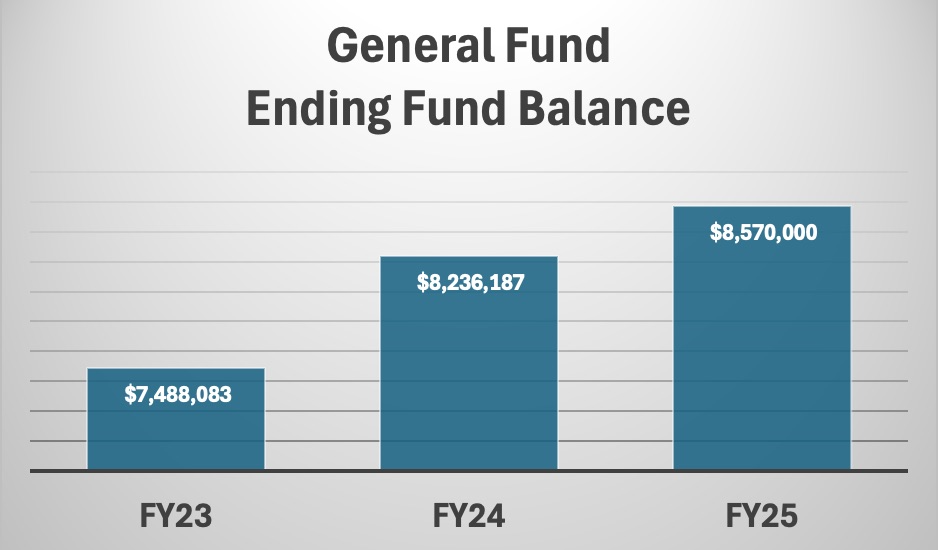
In brief, all three revenue sources for LCC are up — state funding, property taxes, and tuition revenue. Revenues exceed expenses, and the Ending Fund Balance (i.e., reserves in the general fund) is growing. It has increased by $1M to $8.6M in the past two years as the reserves continue on an upward trajectory and on track to meet the 10% Board policy requirement of approximately $10M for the general fund (i.e., 10%). (These reserves do not include multiple other funds with positive balances.) Cutting $3M per year for three years amounts to $9M, which is not justified by Board policy, nor has it been approved by the Board.

We are grateful the Board voted to postpone this line from their action item in order to allow more time to review the data, especially overinflated expense estimates which they questioned on Tuesday. This time will allow them to fulfill their responsibilities as publicly-elected Board members, to uphold their commitment to represent the people of Lane County, to make decisions in accordance with Oregon’s open meeting law and public budget law, and –as members of our institution’s highest governing body in accordance with state statute–oversee the Administration.

My best regards,

Adrienne

———- Forwarded message ———
From: Adrienne Mitchell <mitchella@lanecc.edu>
Date: Sun, Sep 28, 2025 at 8:09 PM
Subject: Background Information about Budget Forecasts
To: Austin Folnagy <folnagya@lanecc.edu>, <rustj@lanecc.edu>, Steve Mital <mitals@lanecc.edu>, <Weismannj@lanecc.edu>, Zach Mulholland <mulhollandz@lanecc.edu>, <alltuckerk@lanecc.edu>, <maldonadoj@lanecc.edu>

September 28, 2025

Esteemed Board of Education Members,

As promised, I am writing to share additional information with you.

LCC has three primary revenue sources: tuition, state funding, and property taxes – all of which are up and continue on an upward trajectory with revenue exceeding expenses.

This bears out in the growing reserves of the ending fund balance. The FY23 and FY24 figures come directly from the official audit statements linked, and the FY25 estimate was provided by the administrators of the Budget and Finance offices. These data from the external auditors and the Administration confirm that there is no structural deficit because revenues exceed expenses resulting in growth of reserves.
The budget development process for FY27 has not yet begun, nor have the steps that are required by Oregon Public budget law for FY27, let alone future years.

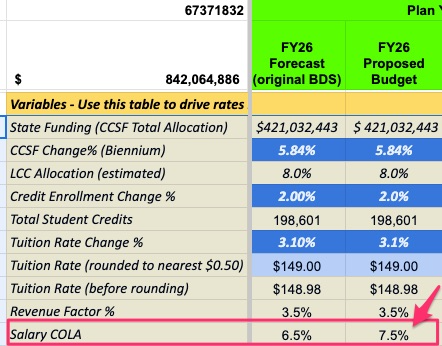
This year’s budget (i.e., FY26) had been balanced by the Budget Development Subcommittee and approved unanimously by the College Council, including students, stakeholders, and all top ranking administrators in voting positions. Even though it was approved unanimously, the Administration presented a different budget to the Board and its Budget Committee in May, making numerous changes, some of which are especially impactful in exaggerating expense estimates. For instance, the Administration changed the COLA (i.e., cost of living adjustment AKA salary schedule increase) built into the budget by increasing it from 6.5% to 7.5% for all employee groups, which added pressure to the budget and resulted in the call to cut $675,000 from the budget, which the Board did approve in June. You can see this increase in the Budget and Finance Office’s own forecasting model, a screenshot of which is below showing the change.
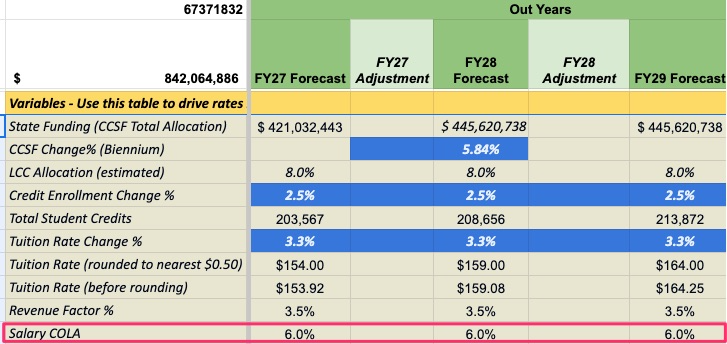
In addition, budget forecasts for multiple future years build substantial COLAs for all employee groups into each year. These compound to significantly overestimate future expenses. Please see below for another screenshot of the Administration’s own forecasting tool showing 6% COLAS built into each and every year for the next three years.
Please note that these COLA figures are merely one example of the assumptions that create an impression of future budget deficits. Other features built into the forecasts that contribute to exaggerated expenses include a vacancy rate set lower than the historic average, among others. It is the use of these unrealistic assumptions that create the forecast of decreasing ending fund balances (i.e. black dotted line), which you can see in the chart below from the Administration’s model.

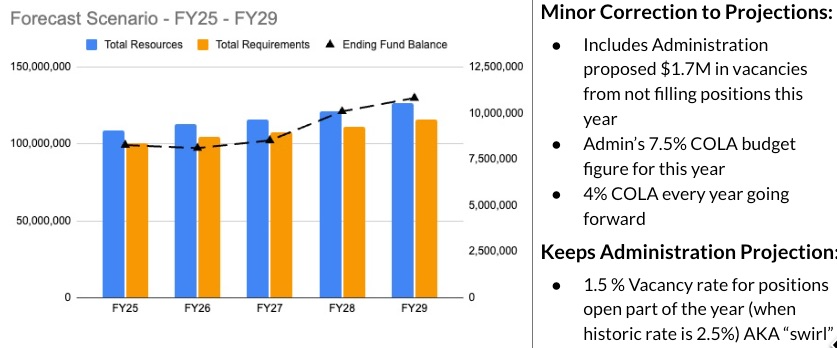
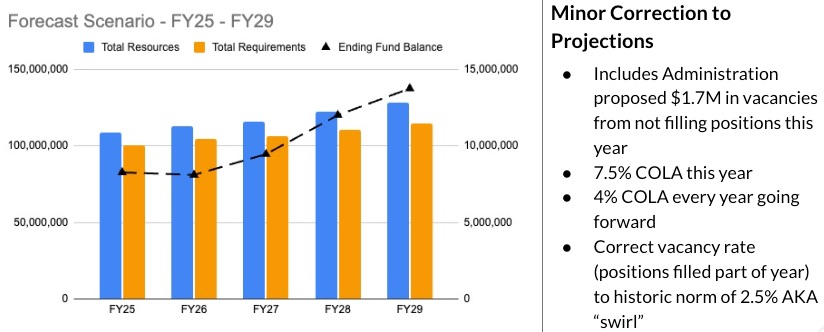
However, if one makes the most minimal adjustments such as including the $1.7M in vacancies the Administration stated on September 3 they will build into this year’ s budget and using 4% as a placeholder figure for COLAs for future years, even while maintaining the Administration’s 7.5% COLA figure for this year, the trajectory is positive, exceeding board policy requirements. Please see the chart below, again utilizing the Administration’s own modeling tool, showing growing reserves with revenue exceeding expenses each year.
And furthermore with the application of the norm for the vacancy rate (i.e., 2.5% AKA “swirl”), the Administration’s forecasting tool shows a substantial increase to reserves, far and above the Ending Fund Balance policy requirement. Please see chart below.
Approving a request by the Administration to make unknown cuts to next year’s budget as well as multiple future years’ budgets raises questions about adherence to state statutes, including public budget law, as well as numerous Board policies (e.g., 6105 6110 6200,  6205 among others). This contravenes the public interest and will further undermine public trust in the institution.

Finally, in order to fulfill your fiduciary responsibility, at the future time when the budget development process does begin and the Board follows all legally-required steps such as formation of the Budget Committee, public hearings, etc., I encourage you to carefully review the assumptions upon which any future year’s forecasts are made. 

In the meantime, I urge you to refrain from approving the President’s goal of budget cuts each year for the next three years’ budgets when the budget development process for FY27 has not yet even begun and to consider ways that the Board can ensure compliance with public budget and open meeting laws.

Thank you for your consideration and, as always, for your service to the people of Lane County.

Sincerely, 

Adrienne

Posted in General | Tagged , , , , , | 1 Comment

LCCEA Provides Legal Memo On Policy and Budget Law Compliance Concerns

Note: The LCCEA has provided the following legal memo to the Lane Community College Board of Education on policy and budget law compliance concerns that the Association has raised this week.

Posted in General | Leave a comment

Bargaining Update: 50¢

LCC Faculty Colleagues –

We would like to say again that if faculty don’t want to lose the benefits and protections of our contract, maximum faculty participation and engagement in collective action—like the one that follows—are necessary.

Please join us on Saturday, October 4, at 4:30 p.m. in front of the Graduate Hotel (66 E. 6th Ave. Eugene) where we will join together with OEA colleagues from throughout the entire state and other local supporters who will be standing together with us in support of LCCEA faculty for a march and rally, which promises to be an uplifting, powerful event.

Today we proposed:

* updated language on faculty privacy rights to both address College concerns and maintain privacy protections (Art. 16);

* updated language on essentials for faculty working conditions that make reasonable adjustments to reassignment time for faculty serving on more than one search committee in a year in order to reach compromise;

* updated language that makes substantial movement toward the College regarding required expenditures for instruction and student services that create an exceedingly reasonable threshold for future investment; (Art. 43); and

* updated language on revision of the contract (once finalized) for gender neutral language – an interest both the College and faculty share in order to address concerns administrators had expressed on deadlines for this revision. 

In contrast, the College proposed increasing the curriculum development rate by 50 cents per hour from $32.50 to $33. In addition, after we had made a proposal back on May 23, 2025 about workload and compensation for faculty to move to a new LMS (i.e., Canvas), the College made its first response by proposing an MOA that would provide a group of only twelve faculty members four (4) hours of compensation each, paid at the curriculum development rate of $33/hour. Each of these twelve faculty members would receive $132 total for the four hours, and everyone else would receive $0. No other compensation or release would be provided to anyone to transition to using Canvas as the LMS for all courses. The only exception is that three (3) hours of Spring Conference would be dedicated to training. 

We did reach a tentative agreement on MOAs that both parties have agreed to eliminate as well as an MOA on the impacts of the hiatus of the LPN program. We also reached agreement to incorporate gender neutral language into the contract once bargaining is complete.

See the links below for today’s proposals:

Sept 30 LCCEA Proposals
Sept 30 Administration Proposals
Sept 30 TA Both Parties

All proposals from both parties are posted on our Bargaining Proposals Page.

Thank you to everyone who made it to bargaining today! At this time, we only have the following six remaining dates scheduled for bargaining. Please join us in building 2, room 214 for part or all of any session. Please note that these dates have changed slightly since our last email due to changes in the schedules of Administrators.

  • Tues., Oct 7, 1-4 p.m.
  • Tues., Oct 14, 1-4 p.m.
  • Mon., Nov 10, 2-5 p.m.
  • Tues., Nov 18, 1-4 p.m.
  • Tues., Dec 2, 1-4 p.m.
  • Tues., Dec 16, 1-4 p.m.

We look forward to seeing you soon, and please look for more information from the Action Team about ways to support faculty goals for our contract.

Your LCCEA Bargaining Team Leads,

Gerry Meenaghan
Adrienne Mitchell
April Myler
Peggy Oberstaller
Ryan Olds
Russell Shitabata

Posted in General | Tagged , , , , , , | Leave a comment

LCCEA President Shares Additional Budget Information with Board of Education

Note: Below is the text of an email sent by LCCEA President Adrienne Mitchell to the LCC Board of Education on Sunday. It outlines additional budget information about the college for Board consideration, in advance of LCC’s Board of Education meeting on Tuesday, September 30, at 6 pm in Building 3, Room 216, on LCC’s Main Campus.

September 28, 2025

Esteemed Board of Education Members,

As promised, I am writing to share additional information with you.

LCC has three primary revenue sources: tuition, state funding, and property taxes – all of which are up and continue on an upward trajectory with revenue exceeding expenses.

This bears out in the growing reserves of the ending fund balance. The FY23 and FY24 figures come directly from the official audit statements linked, and the FY25 estimate was provided by the administrators of the Budget and Finance offices (Fig. 1). These data from the external auditors and the Administration confirm that there is no structural deficit because revenues exceed expenses resulting in growth of reserves.

Fig. 1

The budget development process for FY27 has not yet begun, nor have the steps that are required by Oregon Public budget law for FY27, let alone future years.

This year’s budget (i.e., FY26) had been balanced by the Budget Development Subcommittee and approved unanimously by the College Council, including students, stakeholders, and all top ranking administrators in voting positions. Even though it was approved unanimously, the Administration presented a different budget to the Board and its Budget Committee in May, making numerous changes, some of which are especially impactful in exaggerating expense estimates. For instance, the Administration changed the COLA (i.e., cost of living adjustment AKA salary schedule increase) built into the budget by increasing it from 6.5% to 7.5% for all employee groups, which added pressure to the budget and resulted in the call to cut $675,000 from the budget, which the Board did approve in June. You can see this increase in the Budget and Finance Office’s own forecasting model, a screenshot of which is below showing the change (Fig. 2).

Fig. 2

In addition, budget forecasts for multiple future years build substantial COLAs for all employee groups into each year. These compound to significantly overestimate future expenses. Please see below for another screenshot of the Administration’s own forecasting tool showing 6% COLAS built into each and every year for the next three years (Fig. 3).

Fig. 3

Please note that these COLA figures are merely one example of the assumptions that create an impression of future budget deficits. Other features built into the forecasts that contribute to exaggerated expenses include a vacancy rate set lower than the historic average, among others. It is the use of these unrealistic assumptions that create the forecast of decreasing ending fund balances (i.e. black dotted line), which you can see in the chart below from the Administration’s model (Fig. 4).

Fig. 4

However, if one makes the most minimal adjustments such as including the $1.7M in vacancies the Administration stated on September 3 they will build into this year’ s budget and using 4% as a placeholder figure for COLAs for future years, even while maintaining the Administration’s 7.5% COLA figure for this year, the trajectory is positive, exceeding board policy requirements. Please see the chart below, again utilizing the Administration’s own modeling tool, showing growing reserves with revenue exceeding expenses each year (Fig. 5).

Fig. 5

And furthermore with the application of the norm for the vacancy rate (i.e., 2.5% AKA “swirl”), the Administration’s forecasting tool shows a substantial increase to reserves, far and above the Ending Fund Balance policy requirement. Please see chart below (Fig. 6).

Fig. 6

Approving a request by the Administration to make unknown cuts to next year’s budget as well as multiple future years’ budgets raises questions about adherence to state statutes, including public budget law, as well as numerous Board policies (e.g., 6105 6110 6200,  6205 among others). This contravenes the public interest and will further undermine public trust in the institution.

Finally, in order to fulfill your fiduciary responsibility, at the future time when the budget development process does begin and the Board follows all legally-required steps such as formation of the Budget Committee, public hearings, etc., I encourage you to carefully review the assumptions upon which any future year’s forecasts are made. 

In the meantime, I urge you to refrain from approving the President’s goal of budget cuts each year for the next three years’ budgets when the budget development process for FY27 has not yet even begun and to consider ways that the Board can ensure compliance with public budget and open meeting laws.

Thank you for your consideration and, as always, for your service to the people of Lane County.

Sincerely, 

Adrienne

Posted in General | Tagged , , , , , , | Leave a comment

LCCEA President Urges LCC Board to Honor Public Interest

In response to a surprising action item added to Tuesday’s LCC Board of Education agenda, LCCEA President Adrienne Mitchell has written a letter (below) to Board members calling for adherence to the law and multiple Board policies.

Esteemed Board of Education Members,

I’m writing to report concerns about information shared at the all-campus inservice and now included in an agenda item on your September 30 Board meeting.

It was reported yesterday that the Board of Education has approved a plan to cut $3M from the budget each and every year for the next three years. I have the great honor of attending all of your public meetings, including work sessions. I also carefully review your agenda items and decisions. I am grateful for the opportunity to observe the democratic process in action as you serve the public in your roles as elected Board of Education members. I have observed that there have been no votes of the Board to adopt $3M in budget cuts every year at any of these public meetings or public work sessions. As you likely know, Oregon has open meetings laws requiring Board decisions to be made in public, and for this reason, we know that a decision to make cuts for FY 27 or several years out has not been approved.

However, I did notice that there is now an item on the agenda for your meeting this coming Tuesday, September 30, which seeks your approval and decision to cut $3M from the budget every year for the next three years. This is one line found on page 6 of the 11-page powerpoint presentation, which seeks Board approval, posted on BoardDocs at: https://go.boarddocs.com/or/lanecc/Board.nsf/files/DLTU4T7A4805/$file/President’s%20Goals%2C%20Evaluation%20Standards%2C%20and%20Expectations%202025-26%20Final%209.3.2025.pdf.

In addition, you are likely aware of Oregon’s public budget law. I am including (see below) a presentation that the Administration members of the LCC’s Budget and Finance offices have presented, which includes the public budget law steps that are required for public institutions including LCC. In particular, please see page 3 which outlines a number of the important functions of Oregon public budget law, which includes, “Transparency with community input/involvment” and “estimate revenues and expenditures” – critical to any public governing body that must abide by our state’s budget law.

Specifically, please see pages 4 through 6, which outline all the steps required of public bodies in order to fulfill the obligations of Oregon Public Budget Law. These include establishment of a Budget Committee, preparation of a proposed budget, public notice of Budget Committee meetings, a public budget hearing with opportunity to “receive citizen testimony on the approved budget” and numerous steps that safeguard the public interest.

Given that the Board-level budget development process for FY27 is not even scheduled to begin for many months, and the budget development process for subsequent years is more than a year out, I am writing to urge you to take a thoughtful, deliberative, public approach to consideration of the college budget that is consistent with Oregon public budget law. Approving cuts before the budget development process even begins would subvert the statutorily required budget approval process.

Approving a request by the Administration to make unknown cuts to next year’s budget as well as multiple future years’ budgets also raises questions about adherence to numerous Board policies (e.g., 6105 6110 6200,  6205 among others). This contravenes the public interest and would further undermine public trust in the institution that has not yet recovered from the sudden hiatus of the LPN program without a Board vote or public meeting before the decision was made.

In addition, please note that the budget during President Bulger’s has been successful in ensuring that revenues do exceed expenses. This bears out in the growing reserves of the ending fund balance. The FY23 and FY24 figures in the graph below come directly from the official audit statements (also linked), and the FY25 estimate was provided by the administrators of the Budget and Finance offices. These data from the external auditors and the Administration confirm that there is no structural deficit because revenues exceed expenses resulting in growth of reserves.

Finally, in order to fulfill your fiduciary responsibility, I encourage you to carefully review the assumptions upon which any future year’s forecasts are made. I will provide more detail regarding those forecasts in the upcoming days.

Thank you, as always, for your service to the people of Lane County.

Sincerely, 

Adrienne

Posted in General | Tagged , , , , , , | Leave a comment