Our Mission: LCCEA engages in collective action to ensure an equitable learning and working environment and advocates for social justice and systemic change for the public good.
LCCEA’s attorney, Luke Kazava, identifies serious contractual and legal issues related to the Board of Education vote on budget reductions. Kazava writes,
“The College’s proposed retrenchments include layoffs that would violate the seniority clause (Article 10, Section 10.3) of the parties’ contract. Several faculty have been unlawfully targeted by the College for layoff… “
“Alarmingly, the proposed layoffs target Association officers and other faculty who recently participated in grievances or filed complaints against the College, including three faculty of color who filed racial discrimination complaints against the College. The proposed
layoffs appear to be acts of retaliation against employees for engaging in legally protected activity, in violation of ORS 243.672(1)(a). The College’s targeted layoffs may also violate state and federal laws prohibiting racial discrimination and whistleblower retaliation.”
If you have not yet read LCCEA President Adrienne Mitchell’s emails from September 24 and 25 regarding proposed budget cuts, please read these highly important emails for context.
The time to act is now! The Board of Education needs to hear from us. The Board is being pressured to vote on program & service cuts amounting to 3.8 million dollars. Rushing to vote this week is unnecessary and doesn’t make sense. Can you take a few minutes to send a letter to the Board? You can add your own text or send as is:
Let’s stand together in solidarity! Please sign up here to let us know what other actions you can take:
Come to the LCC Board of Education meeting this Wednesday at 6pm. The meeting is in the Boardroom, Building 3, Room 216. Wear red!
Join us at our rally at 5:00 p.m. before the meeting on the 1st floor of the Center Building. We’ll have some red shirts available, and pizza will be provided by the LCCEA. We’ll then walk to the Board meeting together. Our Classified Professions will join us too.
Speak during the public comment at the Board meeting.(Up to 3 minutes, we can help you write your statement. Be prepared to provide comments in 2 minutes if the Board reduces the time available.)
Pressuring the board to vote now on program and service cuts amounting to 3.8 million dollars is premature and unnecessary.
In early October we will have two key pieces of information that will clarify our financial picture. LCC’s percentage of the Community College Support Fund will be recalculated, and will likely increase, according to the Higher Education Coordinating Commission and Interim VPFO Sue Fahey. We will also know the tuition revenue by Oct. 3 – that’s just next week! Why vote on cuts now when this information will change the budget picture?
Our contract states that for cuts to take place in January, the college needs to have 30 days of good faith discussions with alternatives first. Then the Board could vote 60 days before winter term, by November 8, provided the 30 day discussion happens. If cuts are to happen, the president & board need to follow the contract process.
The Administration’s proposed cuts target faculty who have made complaints of managers’ acts of discrimination, harassment, and/or retaliation.
The Administration’s proposed cuts also disproportionately impact faculty from historically oppressed groups and target your LCCEA elected officers.
These cuts make no sense, are rushed and needless. Let’s stand together for our students, classified colleagues and our entire community!
In Solidarity,
Paula Thonney and Wendy Simmons, Your LCCEA Action Team Co-Chairs
LCC FACULTY AND CLASSIFIED RESPOND TO PROPOSED SUDDEN BUDGET CUTS
LCC Administration is pushing for a Board of Education vote on $3.8 Million in budget cuts at a Special Meeting on September 27, 2023 at 6:00 p.m. Proposed cuts have not been announced publicly, but administrators provided faculty and classified union officers with lists of planned reductions to take effect in January.
Proposed cuts include: elimination of the French program, elimination of three faculty counselor positions, elimination of the majority of Health classes, four full-time classified positions as well as many part-time classified positions across campus, part-time librarian budget reductions, and reduction of faculty staffing in skills development courses for students.
Cuts would impact three BIPOC faculty members, the only bilingual/bicultural counselor, and three faculty union officers. Half of the full-time classified positions being cut are filled by workers who were deemed “essential front line” during COVID-19 shutdowns, and worked on campus at Lane throughout the pandemic.
“The cuts strike at the very heart of our institution and our instructional and student services mission. We need more support for our students and more faculty from historically oppressed groups, not fewer.” LCCEA Faculty Union President Adrienne Mitchell stated. “We are also deeply concerned about faculty who filed complaints about racial discrimination or retaliation who are now on “the list” for layoffs.”
“Is this union-busting?” asked Physical Therapy Program Coordinator and LCCEA Vice President for Career Technical Faculty, Christina Howard, in response to news that cuts would impact three faculty union officers.
To classified professionals, who are currently in contract negotiations with the college, it certainly feels so. “The administration gave themselves a raise this year, and now they’re looking to lay us off, cut our benefits, and give us raises that in many cases won’t even cover the loss in benefits they’re proposing,” says LCCEF President Frankie Cocanour, “it feels like a scare tactic.”
Budget cuts may be unnecessary. Enrollment is up more than 10% for Fall according to LCC’s Institutional Research department, and state funding for community colleges increased 12.3% this biennium. Details about tuition revenue will be available October 3, and updated state funding allocations will be available in early October.
The LCC Board and Budget Committee approved a $3.8M “reserve for revenue shortfall” in this year’s budget, but revenue information is not finalized, so it is unclear what the amount of a revenue shortfall will be, if any.
Cutting programs and services LCC students and the community rely on is premature.
LCC Faculty, Classified Professionals, and concerned community members plan a rally at 5:00 p.m. at the LCC Cafeteria on Main Campus before the 6:00 Board meeting this Wednesday, September 27.
We are writing to share information about the Administration’s proposed budget cuts. We have received a response from the Administration about one question we had about the data they provided late Friday. However, administrators have declined to meet to answer the other questions until after this Wednesday’s Board meeting. In the meantime, we are sharing the information that has been made available by the Administration so that all faculty are fully informed.
For faculty, the Administration’s proposed reductions, which they propose to take effect in January and which they are asking the Board to vote on this Wednesday, include:
* Elimination of what remains of the already reduced French program
* Elimination of three faculty counselor positions
* Elimination of the vast majority of classes in the Health discipline, impacting all part-time faculty in Health and one of the two full-time faculty in Health
* Partial reduction of the one full-time faculty position in the Academic Learning Skills Department
* Reduction of the budget for part-time faculty librarians (The amount and scope are unknown)
There are also four contracted classified positions identified for layoff. In addition, the part-time classified budget for Instructional Testing Services is proposed for reduction. (The amount and scope are unknown.)
At the same time, there are no proposed reductions to managers.
In addition to the impacts outlined above, the reductions to faculty, if they are implemented, could also impact other faculty indirectly through bumping and/or displacement of part-time faculty.
Furthermore, the affected faculty under the Administration’s cuts proposal include:
* Three faculty who identify as faculty of color
* The only bilingual/bicultural counselor
* Three of your elected LCCEA officers
* Several faculty who have recently filed complaints against managers regarding racial discrimination and/or resolved other issues related to retaliation, discrimination, harassment and the like
Look for more information from the LCCEA Action Team soon and please plan to wear red to the Board meeting this Wednesday at 6 p.m.
I’m writing to extend a most warm welcome to Fall term and to share some important updates.
It was wonderful to see so many of you throughout inservice last week and at the All Faculty Meeting on Thursday. This coming week will be both exciting and important as we welcome students to our classes and campus. As of last week enrollment for Fall is up 10.3% for credits (which drive tuition revenue) and 11.0% for FTE (which impacts state funding). As faculty, we will have our hands (and hearts!) full with the excitement and busyness of week 1!
At the same time, late last week we learned the Administration is proposing program and service cuts while many questions about the budget remain unanswered. Below you will find updates about this. In a future update, we will also provide more information on the student health clinic, which will remain open to serve students this year as well as a recent agreement with the college on making permanent items from the SB551 MOA such as expanded eligibility for part-time faculty family healthcare, increased inservice hours for part-time faculty, and paid time for contracted faculty.
Please also stay tuned for more information this week in advance of the Board of Education’s Special meeting, which was called for this Wednesday, September 27 at 6 p.m.
Budgetary Context
I think it is important to understand the highly irregular context of budget development during May 2023 for this fiscal year.
At the beginning of FY23 on July 1, 2023, there was more than $8M in the ending fund balance for Fund I, according to the official audit document. LCC had successfully re-built the ending fund balance over the course of three years to ensure that $8M was in place June 30, 2022. This was a collective effort, which included the sacrifice of faculty through furlough days in the Workshare agreement of 2020.
By May of 2023, however, there were several conflicting reports of ending fund balances for the same Fund I. The Administration made reports to the Board and Budget Committee as outlined in the table below, some of which took place on the same day at the same meeting. Since that time, no definitive information has been made public.
Date of Report to Board/ Budget Committee
May 3, 2023
May 3, 2023
8 a.m. May 10, 2023
4:55 p.m. May 10, 2023
May 17, 2023
May 24,2023
September 2023& Over Summer
FY23 Ending Fund Balance
$7,834,450
$3,688,667
$5,064,266
$2,524,266 (or $5,064,266 including contingency)
2,524,266 (plus 1,398,300 contingency)
$3,646,566, plus 1,398,300 contingency
July Estimate: $4.7M but won’t be finalized until mid-Oct. according to VPFO Fahey
According to Interim VPFO Sue Fahey, the ending fund balances for FY23 will not be finalized until later in October. According to information she provided to LCCEA, the most recent data available (from July 2023) indicates that spending was over budget by a total of $5.7M in Funds I and IX during one single year (FY23).
Please note that the Administration also reported that salaries in Fund I were under budget in FY23 and cannot explain the overspending of the budget. M&S (i.e., materials and services) was reported to be overspent by $2.3M, and two errors (in the amounts of $1.7M and $2.1M) were also reported by the Administration at Board and Budget Committee meetings in May.
Other Factors Impacting Budget Timelines
The budget approved for this year requires setting aside $3.8M in a “reserve for revenue shortfall.” It is not yet known how much a revenue shortfall, if any, will be. However, significant new information about revenue will be available within the next two weeks.
First, tuition will be assessed on October 3 – one day before the October Board meeting. Fall is the term with the highest enrollment and represents one third of the year, and information about tuition revenue for Fall will be definitive shortly. The last report of enrollment from just last week is that it is up 10-11% over last year, far exceeding the 5% increase built into the budget.
Second, Interim VPFO Sue Fahey, has reported that the Higher Education Coordinating Commission (i.e., the HECC) will recalculate each college’s percentage allocation of the Community College Support Fund (i.e., CCSF, which is state funding) in early October. LCC’s allocation is expected to increase due to enrollment increase at LCC as well as due to the enrollment decrease at PCC, which has a significant impact on the funding formula for all the other colleges. Furthermore, overall the CCSF is increasing by 12.3% over the last biennium.
Third, VPFO Sue Fahey has also reported that definitive information about LCC’s Ending Fund Balance in Funds 1, 9, and other funds will be available later in October. In a recent meeting with LCCEA and LCCEF, she expressed optimism. While the dramatic variations in amounts reported are concerning, we look forward to more definitive information about the actuals as the auditors complete their work and are optimistic that LCC did not overspend its budget in Funds I & IX by more than $5.7M in a single year.
All of these pieces of information are critical to understanding the budget and what revenue shortfall, if any, there will be.
Possible Program and Service Reductions and/or Eliminations
Even though the amount of a revenue shortfall, if any, has not been confirmed, the Administration presented a package of reductions at the Board of Education work session last week. The Administration reported that of the $2.6M in proposed reductions in “personnel,” $1.6 would be in the form of vacant positions, and the remaining $1M would be layoffs of part-time and full-time employees, which they are proposing to take effect January 1.
In addition, the Administration has asked the Board to hold a special meeting this Wednesday. As of the writing of this email, the only action item on the agenda is, “The board will vote on approving the implementation of the FY24 budget balancing package,” and the specific program and/or service reductions and/or eliminations are not posted publicly.
LCCEA made a formal information request on September 15 for a complete list of planned reductions and received a spreadsheet from the Administration at the end of the day on Friday, September 22. Since Friday we have been in the process of speaking with all faculty who could be impacted based on the information provided. However, due to a lack of clarity and inconsistencies in the actual data provided by the Administration, we have requested additional information from the Administration. We hope to receive clarifications on Monday. More information will be provided to all faculty as soon as possible after we receive clarifications about the data.
Please also stay tuned for more information from our Action Team Co-Chairs, Wendy Simmons and Paula Thonney.
Contractually Required Timelines for Faculty Retrenchments
Anyone who attended the Board’s work session last week is likely aware that there may be confusion as well as a sense of urgency specifically regarding timelines for decision making for any program and/or service reductions that may necessitate layoffs.
The LCC Board of Education’s agreement with the Lane Community College Education Association (our contract) requires the following.
First, the College must provide notice to LCCEA, This notice is typically provided in an email with a request for a meeting(s). LCCEA has not received this notice yet, and the Board of Education has never voted in the past about such notice(s). We’re not aware of any policy that would require a Board vote about these notices to the Association.
Second, the College and LCCEA must meet over a period of thirty days to engage in good faith discussions about the proposed layoffs and to discuss alternatives. LCCEA representatives work in concert with faculty and others in programs that might be impacted in development and presentation of alternatives.
Third, in instances where alternatives cannot be found and mutually agreed, the Board of Education, as required by Board policy, engages in deliberations and votes regarding program and/or service reductions or eliminations, and, at that time, individual faculty impacted are provided notice. This notice must be sixty days before the layoff occurs, not ninety.
While the 30 plus 60 days add up to 90, there is no reason why a Board of Education vote is required this week or even in October for any layoffs that would take effect at the beginning of January. In fact, if the Board of Education were to vote now to cut or reduce programs before the Administration engages in good faith discussions with LCCEA, that would result in a contract violation and an unfair labor practice complaint and likely costly attorney fees for the college (similar to, but not entirely the same as, the unfair labor practice that is being settled between LCCEA and LCC due to improper notice and timelines for the suddenly proposed health clinic closure last Spring).
Please note: despite confusing information provided to the Board at their work session last week, there will be no requirement that the Board vote now on program or service cuts, and they could wait until November 1 because the earliest that any retrenchments would take effect is in January at the beginning of Winter term.
Furthermore, pushing a rushed vote this week does not allow the Board of Education to consider the critical information that will be known about Fall tuition revenue by October 3 and state funding in early October – both of which are essential to knowing the amount of any revenue shortfall or if a revenue shortfall even exists.
Actual Budgetary Impacts of Faculty Layoffs
As you are likely aware, the college rarely, if ever, realizes substantial savings from full-time faculty retrenchments because faculty work is so closely tied to revenue, and when contracted faculty transfer to other areas for which they are qualified, they continue to maintain their positions but most frequently displace part-time faculty in the programs where they transfer, which only increases the cost of those programs. The increased cost of programs where faculty transfer after retrenchment, coupled with the loss in tuition revenue and FTE from the programs that were eliminated, most frequently has a negative impact on the bottom line, not to mention impacts on students.
Standing Together
While this past year has been a challenging one for our campus with:
Reports of budgetary irregularities, errors, and ongoing unknowns;
Efforts to re-frame our shared governance system as one that makes recommendations only;
Suppression of speech in a variety of campus contexts affecting faculty work and academic freedom;
The dismantling of LCC’s Office of Diversity, Equity, & Inclusion;
Last Spring’s proposal to close the student health clinic and the administration’s limitation of student access to reproductive healthcare at the clinic; and now
Pressure for budget cuts to be decided immediately before critical information about revenue becomes available.
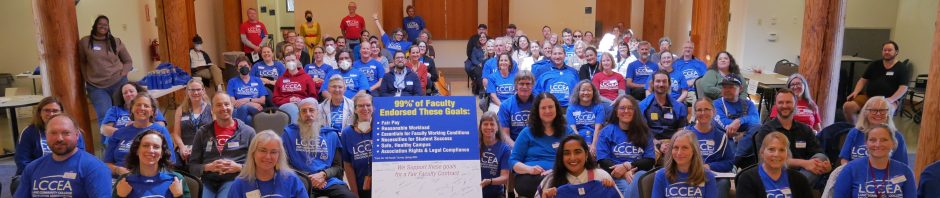
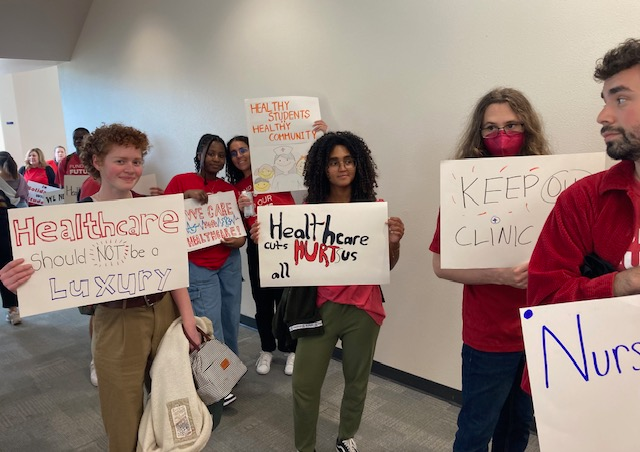
This is also a time of incredible, inspiring solidarity between faculty, our classified colleagues, and students. The days and weeks ahead are not only important for faculty and our livelihoods but also for the future viability and vibrancy of our campus. The May and June rallies that helped save the student health clinic epitomize the power of our collective voice and what we can all do, working together for the common good. (Photo below.)
Standing together we will center our critical instructional and student services mission, the quintessential role of a community college in a vibrant democracy, and we will continue to create the campus our community deserves.
It is a great honor and a privilege to stand together with you all.
In solidarity,
Adrienne
Dates for Your Calendar
6:00 p.m., 9/27/23, Board of Education Special Meeting (More info to come from Your LCCEA Action Team)
6:00 p.m., 10/4/23, Board of Education Regular Meeting
5:45 p.m., 10/19/23 LCCEA private screening of “Made in Dagenham” at Broadway Metro theater in Downtown Eugene, RSVP here, “Made in Dagenham” is the true story of a group of working-class English women who walked off the job – protesting their wages at the Ford Motor Company. (More details to come from the Membership Committee.)
TBD, Fall Term Department Rep Meetings (Find LCCEA committees & department reps here.)
6:00 p.m., 11/1/23,Board of Education Regular Meeting



 Lane Community College Education Association