Important Bargaining Update 4.4.22

LCC Faculty Colleagues,

Your LCCEA Bargaining Team has been engaged in a thorough analysis of the College’s bargaining proposal.

According to our contract, this economic reopener must be limited to economics (e.g. salary, etc.) and up to three non-economic issues per party.

We see the College’s proposal as disappointing in the extreme and strongly encourage all faculty to consider the significant impact that implementation of this proposal would have not only on faculty working conditions and faculty jobs – both full-time and part-time –  but also on our collective ability to serve students and keep highly qualified, dedicated faculty at LCC. The College’s proposal appears to be an affront to all faculty and to our contract.

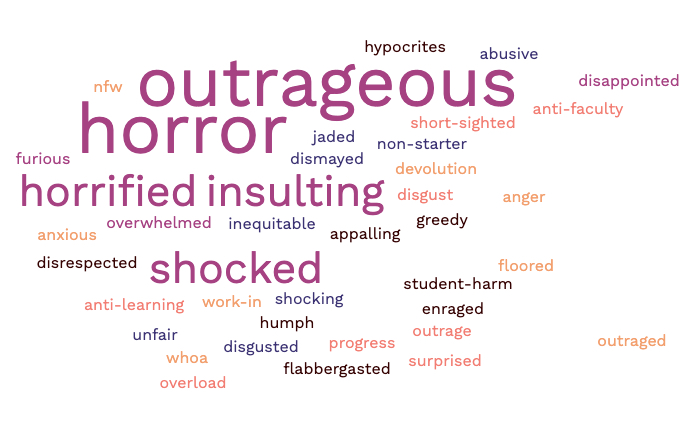
(In addition to the summaries below, please find at the end of this post: a chart that compares the LCCEA and College proposals along with examples of how we estimate workload would be impacted in departments across campus. After reviewing the College proposal, please complete a very brief survey to share your reaction and feedback at: https://forms.gle/ezipyhJJ4QneQ2er7 It will take just 1-2 minutes.)

The College has presented a proposal that:

  • Modifies 29 articles of our contract (some with non-substantive changes);
  • Includes approximately 14 distinct non-economic issues;
  • Modifies or eliminates 13 MOAs;
  • Provides an economic offer of 1.5% COLAs;
  • Adds one paid work day for contracted faculty but no additional inservice/meeting hours for part-time faculty; and
  • Pays for economics and appears to produce a net reduction in total faculty compensation and benefits expenses for the College by:
    • Extracting significant workload increases;
    • Making 45 TLCs/credits a minimum instead of a maximum for all full-time faculty (except for Advanced Technology and Aviation Maintenance which would maintain a 51 TLC requirement);
    • Making overloads mandatory for full-time faculty who do not have assignments of 45 TLCs/credits (the majority of faculty) with most full-time faculty assigned one or more additional courses;
    • Paying only part of the overload course, resulting in effective salary rates well below the 85% overload rate and below part-time salary rates;
    • Removing class sizes from the contract;
    • Removing other workload parameters and limitations (e.g. number of sections, number of preps, total number of students);
    • Increasing the number of courses the majority of full-time faculty teach;
    • Removing compensation for part-time faculty to complete required assessment activities;
    • Setting the TLC factor for lecture-lab at .762, increasing workload for contracted faculty and decreasing compensation for part-time faculty in several departments;
    • Allowing classes to be assigned up to double the “established” but no longer documented class size with stipends for large classes based on end of fourth week enrollment;
    • Displacing part-time faculty from work, resulting in substantial layoffs at a time when we have already lost 20% of our part-time faculty; and
    • Also resulting in reduced numbers of full-time faculty in future years.

Among other changes, the College also proposes:

  • Removing all contract language that refers to an inflation index used to ensure salaries are not eroded by inflation over time;
  • Providing an additional 0.5% COLA to part-time faculty only if PT faculty loads are increased to 0.75 FTE, resulting in job loss for approximately 12.5% or more of part-time faculty at times of enrollment decline or stagnation;
  • Increasing maximum TLC/credit load for full-time faculty to 18.5 TLCs/credits per term;
  • Allowing full-time faculty to teach 0.5 FTE overloads (after mandatory overloads paid effectively well below regular overload rates) before part-time faculty with seniority receive assignments during the academic year; 
  • Increasing assigned workload hours for non-instructional faculty (e.g. counselors);
  • Removing protections against class cancellations;
  • Removing the Workload Taskforce Findings MOA (just mutually agreed less than 2 years ago after six years of joint LCC-LCCEA work);
  • Removing the Assignment Rights / Assignment Order MOA; 
  • Removing the Distance Learning MOA; and
  • Modifying Academic Program Review to reduce the role of faculty in determining committee membership within the program as well as some faculty roles on APROC.

Your LCCEA Bargaining Team presented a proposal to meet faculty interests indicated by the All Faculty Survey with 249 participants and based on background data showing that faculty salaries have fallen behind when compared with other community colleges, local teachers, and with our hard working colleagues right here at LCC.

The LCCEA proposal:

  • Provides COLAs set at actual inflation rates determined by the federal government to prevent salaries from falling further behind inflation;
  • Provides pay parity for part-time faculty with a new salary schedule (part-time faculty step on to the new schedule at the next highest amount moving incrementally toward parity on the schedule with step advancement each year); 
  • Adds 1.5 steps at the top of the salary schedules to partially address the gap between LCC faculty salaries and other groups on and off campus
  • Restores the work year to 175 days for contracted faculty, and adds 16 hours inservice/meeting pay for part-time faculty
  • Adds Juneteenth and Indigenous People’s Day as paid holidays in accordance with their recognition by the State of Oregon;
  • Expands the definition of family members to be more inclusive for the purpose of paid and unpaid leave time (e.g. parental, family, and medical leave) and tuition waivers
  • Provides LTD bus passes to all faculty
  • Adds steps for faculty using bilingual/multilingual skills in their work;
  • Includes three non-economic issues as follows:
    • Increases the lab rate to 1.0 TLC;
    • Protects job security with reasonable procedures for establishing and/or changing minimum qualifications with notice requirements when changes are made and opportunities to ensure faculty remain current in areas for which they are qualified;
    • Centers student success by:
      • Increasing support for student basic needs (e.g. food, housing, mental health, gender-neutral restrooms, campus spaces for worship and lactation)
      • Reducing costs for students (e.g. tuition waiver for undocumented and indigenous students; reducing textbook markup at the bookstore; providing support for OERs)
      • Expanding sanctuary campus protections in accordance with recommendations for institutions of higher education from the National Immigration Law Center;
      • Ensuring basics for instruction are provided (e.g. office space, adequate classroom technology, etc.); and
      • Ensuring campus resources are allocated equitably and in alignment with the college mission.

Please note: steps are provided to all faculty consistent with current contract language.

We will seek clarity from the College on which will be their three non-economic issues, given the limit of three per party and the large number included in the College proposal. We will keep all faculty updated as negotiations progress.

Fill out the Survey

Please do complete our two-minute reaction and feedback survey. You may also wish to be in contact with Action Team Chairs, Peggy Oberstaller and Wendy Simmons, about how to get involved.

Your LCCEA Bargaining Team

Kelly Collins

Joseph Colton

Adrienne Mitchell

Nancy Wood

Posted in General | Leave a comment

Bargaining Update 3.31.22

LCC Faculty Colleagues,

Your LCCEA Bargaining Team met with the College today to exchange initial proposals for the economic reopener for 2022-2024, which also provides that each party may bring up to three non-economic issues.

Please find linked here the complete LCCEA package proposal; below are a brief summary table and background data with survey results and comparative data. In addition to economic proposals, the three non-economics for LCCEA are: lab and lecture-lab TLCs (i.e. workload and compensation factor for lab instruction), job security for part-time and full-time faculty, and essentials for student success.

At today’s session, we presented LCCEA data and the LCCEA proposal. The College then met for a caucus and returned shortly before the scheduled end of the meeting. No time remained for the College to present their proposal, but the College did send it by email, and you will find it below also.

We will follow up with more information, including details and analysis, but wanted to share the proposals with all faculty in the meantime.

Your LCCEA Bargaining Team:

Kelly Collins

Joseph Colton

Adrienne Mitchell

Nancy Wood

Posted in General | Leave a comment

LCCEA President’s Update, March 14, 2022

LCC Faculty Colleagues,

I hope this message finds you well as we wrap up winter term. 

I’m writing with a number of updates for all faculty regarding: legislative news, public service loan forgiveness,  assessment, program modifications and retrenchments, budget, bargaining, and a grievance settlement, retirement incentive, among others.

Legislative Updates, including Public Service Student Loan Forgiveness

The Governor’s workforce bill (Senate Bill 1545 ) passed during the legislature’s short session, which ended earlier this month. The bill will provide additional funding to LCC for next year in excess of $1.1M, not including any grants provided to LCC for credit for prior learning or workforce development in key career technical programs. Thank you to everyone who helped advocate for its passage!

OEA and AFT advocated for an omnibus education bill (SB 1522), which passed and improves eligibility for part-time faculty healthcare statewide, among many other provisions. The bill modifies the calculation for qualifying for healthcare from last summer’s SB 551 in a manner that will help more part-time faculty at public higher education institutions in Oregon receive benefits. For LCC, where healthcare is already provided through our contract, the funding that LCC will receive will increase due to this bill. Funding that LCC receives will be utilized for the benefit of faculty in accordance with our SB 551 MOA (e.g. increased contributions to family healthcare for part-time faculty; increased compensation for part-time and full-time non-instructional time; Justice, Equity, Diversity, and Inclusion Faculty Fellowship positions, etc.)

In addition, through the leadership and advocacy of OEA and AFT, the Oregon legislature passed another bill that helps expand eligibility for part-time faculty statewide who are seeking public service loan forgiveness through the federal program. SB 1572 requires institutions of higher education in Oregon to calculate faculty work hours at a rate of 4.35 hours for every one hour of instruction when reporting hours for the purpose of federal public service loan forgiveness. This improvement from last year’s bill will help even more part-time faculty meet the threshold of 30 hours per week required to qualify as “full time” for public service loan forgiveness. For instance, a faculty member teaching 7 hours per week would receive credit for working 30.45 hours (i.e. 7 x 4.35 = 30.45).

Also – a reminder from last Fall, the Biden Administration has made numerous improvements to the federal public service loan forgiveness program, including a waiver in effect through October 22, 2022 only, which will help many more educators throughout the US have their student loans forgiven. See NEA resources for more information.

In addition, a benefit to all NEA members, which include all LCCEA members, is personalized advice on student loan forgiveness. You can access the loan forgiveness navigator on the NEA member benefits website.

Masks and Safety

There is new mask guidance from the CDC as well as OHA that reduces requirements for masks. As of March 10, Lane County is now the “low” risk category according to the CDC. We anticipate this will be a topic of discussion at Tuesday’s Covid Advisory Team meeting. It is likely that masks will not be required indoors on campus once we reach the point when all the applicable public health guidelines (e.g. LCPH, OHA, OSHA, CDC) no longer require masks indoors. Faculty with safety concerns may report them here.

Assessment

Many faculty members have questions about assessment requirements and related workload and compensation.

Part-time faculty must be compensated for any non-teaching work and may use in-service hours for LCC workshop and/or meeting attendance. In addition, depending on total state reimbursements to LCC as a result of SB551 and the SB551 MOA, which increases both part-time and contracted compensation for non-instructional time, either four or eight hours of the additional inservice hours provided to part-time faculty will be reserved for assessment work, beginning next year.

For contracted faculty, assessment is one of the options for non-teaching work that comprise 15% of contracted faculty time. Individual contracted faculty may choose which non-teaching work to pursue. Examples include discipline, department, division, and collegewide committee service in addition to assessment, long-term curriculum planning, search committees, peer mentoring, and work in the community. There will also be four or eight hours reserved for contracted faculty for assessment during inservice beginning in Fall, depending on total state funding reimbursements.

Program Modifications, One Program Elimination, and Partial Retrenchments

The Board of Education voted in January to modify the Culinary and Manufacturing programs to establish short-term certificate programs in each one. In addition, despite the substantial tourism industry in Lane County, the Board voted in February to eliminate the Hotel, Restaurant, and Tourism Management (HRTM), which had been under review for the past two years. These changes will result in the retrenchment of one faculty member.

Due to low enrollment, the College is also making one partial retrenchment and reassignment of a faculty member in Sociology to teach part of their workload in another discipline.

The College also sought to make a partial retrenchment in the French program mid-year without following contractual notice requirements, but has since agreed not to pursue such action for Spring term.

Finally, the College is reviewing Cooperative Education faculty assignments and has made changes to reassigned time for two Cooperative Education coordinators’ workloads.

Your LCCEA representatives will continue to advocate to ensure that the administration adheres to the contract and honors faculty rights. In all cases, but especially any involving retrenchment or job security, faculty need to be able to rely on their contract.

Section cancellations

LCCEA has received reports of class cancellations from more than one division where the cancellations also negatively impact other course enrollments in the same term or subsequent terms, especially in cases where there is only one section of a course offered or a course is canceled mid-sequence, effectively resulting in the cancellation of the rest of the sequence. In addition, LCCEA has received reports from faculty in more than one division about faculty learning about class cancellations after students have been notified. Affected faculty have expressed concerns about impacts of such cancellations to enrollment and students. If you have similar concerns, please share them with LCCEA at lccea@lanecc.edu

Budget

The College Council Budget Development Subcommittee and the College Council both achieved consensus on a balanced budget framework for next year. The full budget will go to the Board of Education and the Board’s appointed Budget Committee before its adoption in May through June. The projected deficit for FY23 (i.e., July 1, 2022 – June 30, 2023) was reduced to $8.1M, and the committee bridged the gap with a number of strategies, including use of budget surpluses generated last year and this year, coupled with additional state revenue from SB 1545, holding some vacant positions open, moving to a banded tuition model, and maintaining major maintenance funding at a level that does not exceed this year’s budget in accordance with our institutional commitment to Lane County voters who supported the LCC bond. Overall, the LCC budget is far more stable than at any time in the past five years because federal relief funding has restored reserves (e.g., ending fund balances) with budget surpluses over the past two years. A big thank you to Jim Arnold, LCCEA VP for Part-time Faculty, who also served as an LCCEA representative on the committee.

Bargaining

College representatives have delayed negotiations, first informing LCCEA that they would not be ready to make proposals on the economic reopener until March 10 and later postponing to March 31. Your LCCEA Bargaining Team will keep faculty updated as negotiations progress. In the meantime, please do not hesitate to reach out to your LCCEA Bargaining Team members: Kelly Collins, Joseph Colton, Nancy Wood, and myself.

In preparation for negotiations, your LCCEA Bargaining Team has been engaged in comprehensive data analysis for several months, including results from the November All Faculty Survey as well as comparative local and regional data.

While our 2019 contract made important gains for faculty, including pay parity adjustments for part-time faculty, inflation has dramatically increased, and faculty salaries are also losing ground since 2019 when compared to other public sector employees locally and in the state, who have received well-deserved increases. For example, when comparing part-time and full-time faculty top of the schedule salaries at LCC with other salaries at the college and in the local area such as 4J teachers, faculty increases lag behind. (See comparison chart below.)

In addition, a comparison of total contracted salary expenditures at the aggregate at LCC also demonstrates a similar lack of investment in faculty.

Faculty also receive below average compensation for lab instruction compared to other community colleges in the state. For contracted faculty, this means more teaching time is required for a full-time workload for lab or lecture-lab instruction. For part-time faculty, this means less FTE and commensurate compensation for courses with labs or lecture-lab time. (See below.)

All Faculty Survey

Thank you again to the 249 faculty who participated in the All-Faculty Survey in November! Data overwhelmingly indicate heavy faculty workloads as well as compensation gaps, causing substantially higher percentages of faculty (both part-time and full-time) to rely on government assistance compared to previous surveys. These and other data will inform LCCEA advocacy in bargaining.  Please contact Action Team Co-Chairs, Peggy Oberstaller and Wendy Simmons, to learn about how to get involved.

Workload and Uncompensated Time

➔   74.1% of faculty respondents work more than their assigned and compensated FTE with 34.3% working 21% or more over their assigned and compensated FTE

➔   96.7% work some evenings or weekends (outside of regularly assigned times) with 84.2% working evenings and/or weekends at least half of the weeks each term.

Necessity and basic needs

➔   36% of part-time faculty who are not retired and 8.3% of full-time faculty reported having relied on government assistance while working as faculty at LCC.

➔   10.2% of part-time faculty who are not retired experienced food insecurity, 2.8% of contracted faculty experienced food insecurity during the last year.

Settlement Agreement

At the end of February, LCC and LCCEA avoided litigation by reaching an agreement to settle a grievance in the Flight Tech program that provides a process for managers to teach classes during emergency staffing situations on a temporary basis. The agreement maintains strong protection for faculty by requiring that the College follow multiple steps and provide documentation of each step to LCCEA before any manager would teach a class in such emergencies. In such cases and on a temporary basis only, the College must demonstrate that no part-time faculty members are willing to teach the class; no part-time faculty are willing to accept a temporary contracted faculty position; no contracted faculty are willing to accept an overload assignment; and posting the position resulted in no qualified applicants. While such emergencies are extremely rare, the settlement does provide a reasonable approach for ensuring continuity of services to students if they do ever occur.

Reminder: Contracted Faculty Retirement Incentive Deadline April 1

LCCEA and the College reached an agreement on a retirement incentive for contracted faculty. Please see below for details. 

To be eligible for the incentive, individuals must:

·       Be a contracted faculty member (i.e., not part-time);

·       Be at least 55 years of age by December 31, 2022;

·       Be currently on payroll as a contracted faculty member at LCC; and

·       Have been hired into a faculty position at LCC no later than October 2018.

For eligible faculty, the incentive agreement provides:

·       $15,000 if separating from contracted employment with LCC by or before June 30, 2022, OR

·       $10,000 if separating from contracted employment with LCC by or before December 31, 2022, OR

·       One year employee-only health insurance if not eligible for early retirement provisions under Article 41 AND

·       Tuition waivers for one year for retirees for an unlimited number of classes as long as space is available (beyond the one class / term emeritus tuition waiver provided in Article 19.6 of the LCCEA working agreement).

Above incentives are provided in addition to Article 41 retirement benefits and stipend, if applicable. Eligible faculty who have previously communicated during the 21-22 academic year their plan to retire or separate on or after April 1, and who meet the eligibility criteria shall be eligible. Finally, should the College provide incentives to managers or classified that exceed the incentive provided to faculty, the incentive for faculty shall be increased to match.

OEA Benefits

Among many other benefits, OEA Workshops and Events are free to members and provide a variety of offerings every month.

Wrapping up the term

As Winter wraps up and we prepare for the last term of the academic year, I pause to reflect on the past two years. Amid global tumult from the pandemic, a new war in Ukraine, countless other humanitarian crises, racial violence and discrimination in the US, and an assault on the US Capitol in 2021, our work becomes ever more important. It is critical that we continue to galvanize support for public education, center the open access social justice mission of the community college, strengthen opportunities for our students to think critically and engage in thoughtful analyses, and increase civic engagement, all of which underscore the quintessential role of community colleges in a vibrant democracy and make salient the connection between our work and the common good.

Best wishes that finals’ week goes as smoothly as possible. I hope you all are able to enjoy some time away from campus for spring break.

In solidarity,

Adrienne

Posted in General | Leave a comment

Action Alert: Community College Funding

Governor Kate Brown has proposed a workforce bill (SB 1545) that will provide substantial new resources, including:

* Funding earmarked for Career Pathways programs at community colleges and

* Grants available to community colleges for educational programs in: healthcare, manufacturing, and construction

See flyer below for a brief explanation of the bill.

You may wish to consider taking action by sending an automated letter to advocate for the passage of this bill, which will bring much needed funding to community colleges. The legislative session is short and ends in just a few weeks, and it takes just one minute to send your support.

Thank you for your consideration!

Posted in General | Leave a comment

Bargaining Update

LCC Faculty Colleagues,

Please find details below on a new MOA and Economic Reopener bargaining.

MOA on Part-time Faculty Compensation for Specific Committees

A new agreement between LCCEA and LCC provides compensation at the rate of two hours pay for every one hour of meeting attendance for specific committees for part-time faculty. (Link.) The additional hour is provided to account for committee work outside of committee meeting time.

These committees are:

Academic Program Review Oversight Committee and associated APR committees

Academic Requirements Review Committee

Curriculum Committee

Institutional Effectiveness Committee

Safety Committee

Faculty Professional Development Oversight, Professional Activities, and Faculty Inquiry Group committees

This compensation is similar to compensation for part-time faculty serving on governance councils and is provided in addition to regular inservice hours allotted to part-time faculty.

Economic Reopener Negotiations

Your LCCEA Bargaining Team met with College representatives last Thursday for preliminary discussions about the economic reopener bargaining, which will cover economics for July 1, 2022 through June 30, 2024 as well as non-economic issues. 

Thus far, discussions have been limited to ground rules for the negotiations (e.g. frequency of meetings, etc.). The College has not yet responded as to whether a notetaker will be provided nor made a commitment regarding when they will be ready to exchange proposals with LCCEA. We look forward to resolving these questions so that we may move forward with negotiations on behalf of the faculty.

Your LCCEA Bargaining Team:

Kelly Collins

Joseph Colton

Adrienne Mitchell

Nancy Wood
Posted in General | Leave a comment