Our Mission: LCCEA engages in collective action to ensure an equitable learning and working environment and advocates for social justice and systemic change for the public good.
Your LCCEA Bargaining Team met with the College today to exchange initial proposals for the economic reopener for 2022-2024, which also provides that each party may bring up to three non-economic issues.
Please find linked here the complete LCCEA package proposal; below are a brief summary table and background data with survey results and comparative data. In addition to economic proposals, the three non-economics for LCCEA are: lab and lecture-lab TLCs (i.e. workload and compensation factor for lab instruction), job security for part-time and full-time faculty, and essentials for student success.
At today’s session, we presented LCCEA data and the LCCEA proposal. The College then met for a caucus and returned shortly before the scheduled end of the meeting. No time remained for the College to present their proposal, but the College did send it by email, and you will find it below also.
We will follow up with more information, including details and analysis, but wanted to share the proposals with all faculty in the meantime.
I hope this message finds you well as we wrap up winter term.
I’m writing with a number of updates for all faculty regarding: legislative news, public service loan forgiveness, assessment, program modifications and retrenchments, budget, bargaining, and a grievance settlement, retirement incentive, among others.
Legislative Updates, including Public Service Student Loan Forgiveness
The Governor’s workforce bill (Senate Bill 1545 ) passed during the legislature’s short session, which ended earlier this month. The bill will provide additional funding to LCC for next year in excess of $1.1M, not including any grants provided to LCC for credit for prior learning or workforce development in key career technical programs. Thank you to everyone who helped advocate for its passage!
OEA and AFT advocated for an omnibus education bill (SB 1522), which passed and improves eligibility for part-time faculty healthcare statewide, among many other provisions. The bill modifies the calculation for qualifying for healthcare from last summer’s SB 551 in a manner that will help more part-time faculty at public higher education institutions in Oregon receive benefits. For LCC, where healthcare is already provided through our contract, the funding that LCC will receive will increase due to this bill. Funding that LCC receives will be utilized for the benefit of faculty in accordance with our SB 551 MOA (e.g. increased contributions to family healthcare for part-time faculty; increased compensation for part-time and full-time non-instructional time; Justice, Equity, Diversity, and Inclusion Faculty Fellowship positions, etc.)
In addition, through the leadership and advocacy of OEA and AFT, the Oregon legislature passed another bill that helps expand eligibility for part-time faculty statewide who are seeking public service loan forgiveness through the federal program. SB 1572 requires institutions of higher education in Oregon to calculate faculty work hours at a rate of 4.35 hours for every one hour of instruction when reporting hours for the purpose of federal public service loan forgiveness. This improvement from last year’s bill will help even more part-time faculty meet the threshold of 30 hours per week required to qualify as “full time” for public service loan forgiveness. For instance, a faculty member teaching 7 hours per week would receive credit for working 30.45 hours (i.e. 7 x 4.35 = 30.45).
Also – a reminder from last Fall, the Biden Administration has made numerous improvements to the federal public service loan forgiveness program, including a waiver in effect through October 22, 2022 only, which will help many more educators throughout the US have their student loans forgiven. See NEA resources for more information.
In addition, a benefit to all NEA members, which include all LCCEA members, is personalized advice on student loan forgiveness. You can access the loan forgiveness navigator on the NEA member benefits website.
Masks and Safety
There is new mask guidance from the CDC as well as OHA that reduces requirements for masks. As of March 10, Lane County is now the “low” risk category according to the CDC. We anticipate this will be a topic of discussion at Tuesday’s Covid Advisory Team meeting. It is likely that masks will not be required indoors on campus once we reach the point when all the applicable public health guidelines (e.g. LCPH, OHA, OSHA, CDC) no longer require masks indoors. Faculty with safety concerns may report them here.
Assessment
Many faculty members have questions about assessment requirements and related workload and compensation.
Part-time faculty must be compensated for any non-teaching work and may use in-service hours for LCC workshop and/or meeting attendance. In addition, depending on total state reimbursements to LCC as a result of SB551 and the SB551 MOA, which increases both part-time and contracted compensation for non-instructional time, either four or eight hours of the additional inservice hours provided to part-time faculty will be reserved for assessment work, beginning next year.
For contracted faculty, assessment is one of the options for non-teaching work that comprise 15% of contracted faculty time. Individual contracted faculty may choose which non-teaching work to pursue. Examples include discipline, department, division, and collegewide committee service in addition to assessment, long-term curriculum planning, search committees, peer mentoring, and work in the community. There will also be four or eight hours reserved for contracted faculty for assessment during inservice beginning in Fall, depending on total state funding reimbursements.
Program Modifications, One Program Elimination, and Partial Retrenchments
The Board of Education voted in January to modify the Culinary and Manufacturing programs to establish short-term certificate programs in each one. In addition, despite the substantial tourism industry in Lane County, the Board voted in February to eliminate the Hotel, Restaurant, and Tourism Management (HRTM), which had been under review for the past two years. These changes will result in the retrenchment of one faculty member.
Due to low enrollment, the College is also making one partial retrenchment and reassignment of a faculty member in Sociology to teach part of their workload in another discipline.
The College also sought to make a partial retrenchment in the French program mid-year without following contractual notice requirements, but has since agreed not to pursue such action for Spring term.
Finally, the College is reviewing Cooperative Education faculty assignments and has made changes to reassigned time for two Cooperative Education coordinators’ workloads.
Your LCCEA representatives will continue to advocate to ensure that the administration adheres to the contract and honors faculty rights. In all cases, but especially any involving retrenchment or job security, faculty need to be able to rely on their contract.
Section cancellations
LCCEA has received reports of class cancellations from more than one division where the cancellations also negatively impact other course enrollments in the same term or subsequent terms, especially in cases where there is only one section of a course offered or a course is canceled mid-sequence, effectively resulting in the cancellation of the rest of the sequence. In addition, LCCEA has received reports from faculty in more than one division about faculty learning about class cancellations after students have been notified. Affected faculty have expressed concerns about impacts of such cancellations to enrollment and students. If you have similar concerns, please share them with LCCEA at lccea@lanecc.edu.
Budget
The College Council Budget Development Subcommittee and the College Council both achieved consensus on a balanced budget framework for next year. The full budget will go to the Board of Education and the Board’s appointed Budget Committee before its adoption in May through June. The projected deficit for FY23 (i.e., July 1, 2022 – June 30, 2023) was reduced to $8.1M, and the committee bridged the gap with a number of strategies, including use of budget surpluses generated last year and this year, coupled with additional state revenue from SB 1545, holding some vacant positions open, moving to a banded tuition model, and maintaining major maintenance funding at a level that does not exceed this year’s budget in accordance with our institutional commitment to Lane County voters who supported the LCC bond. Overall, the LCC budget is far more stable than at any time in the past five years because federal relief funding has restored reserves (e.g., ending fund balances) with budget surpluses over the past two years. A big thank you to Jim Arnold, LCCEA VP for Part-time Faculty, who also served as an LCCEA representative on the committee.
Bargaining
College representatives have delayed negotiations, first informing LCCEA that they would not be ready to make proposals on the economic reopener until March 10 and later postponing to March 31. Your LCCEA Bargaining Team will keep faculty updated as negotiations progress. In the meantime, please do not hesitate to reach out to your LCCEA Bargaining Team members: Kelly Collins, Joseph Colton, Nancy Wood, and myself.
In preparation for negotiations, your LCCEA Bargaining Team has been engaged in comprehensive data analysis for several months, including results from the November All Faculty Survey as well as comparative local and regional data.
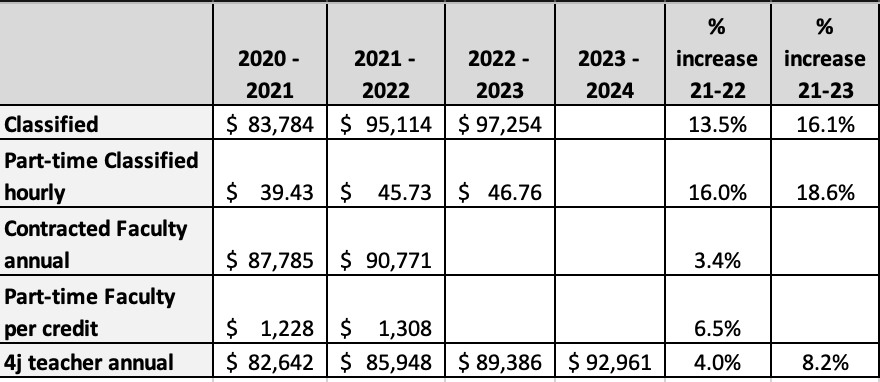
While our 2019 contract made important gains for faculty, including pay parity adjustments for part-time faculty, inflation has dramatically increased, and faculty salaries are also losing ground since 2019 when compared to other public sector employees locally and in the state, who have received well-deserved increases. For example, when comparing part-time and full-time faculty top of the schedule salaries at LCC with other salaries at the college and in the local area such as 4J teachers, faculty increases lag behind. (See comparison chart below.)
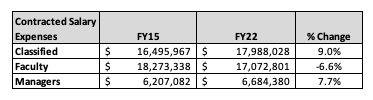
In addition, a comparison of total contracted salary expenditures at the aggregate at LCC also demonstrates a similar lack of investment in faculty.
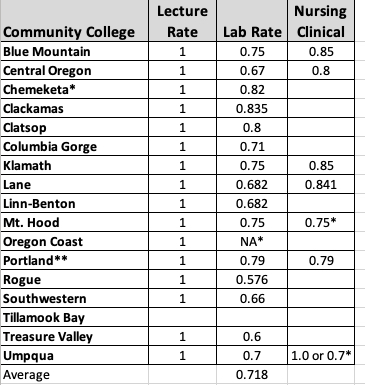
Faculty also receive below average compensation for lab instruction compared to other community colleges in the state. For contracted faculty, this means more teaching time is required for a full-time workload for lab or lecture-lab instruction. For part-time faculty, this means less FTE and commensurate compensation for courses with labs or lecture-lab time. (See below.)
All Faculty Survey
Thank you again to the 249 faculty who participated in the All-Faculty Survey in November! Data overwhelmingly indicate heavy faculty workloads as well as compensation gaps, causing substantially higher percentages of faculty (both part-time and full-time) to rely on government assistance compared to previous surveys. These and other data will inform LCCEA advocacy in bargaining. Please contact Action Team Co-Chairs, Peggy Oberstaller and Wendy Simmons, to learn about how to get involved.
Workload and Uncompensated Time
➔ 74.1% of faculty respondents work more than their assigned and compensated FTE with 34.3% working 21% or more over their assigned and compensated FTE
➔ 96.7% work some evenings or weekends (outside of regularly assigned times) with 84.2% working evenings and/or weekends at least half of the weeks each term.
Necessity and basic needs
➔ 36% of part-time faculty who are not retired and 8.3% of full-time faculty reported having relied on government assistance while working as faculty at LCC.
➔ 10.2% of part-time faculty who are not retired experienced food insecurity, 2.8% of contracted faculty experienced food insecurity during the last year.
Settlement Agreement
At the end of February, LCC and LCCEA avoided litigation by reaching an agreement to settle a grievance in the Flight Tech program that provides a process for managers to teach classes during emergency staffing situations on a temporary basis. The agreement maintains strong protection for faculty by requiring that the College follow multiple steps and provide documentation of each step to LCCEA before any manager would teach a class in such emergencies. In such cases and on a temporary basis only, the College must demonstrate that no part-time faculty members are willing to teach the class; no part-time faculty are willing to accept a temporary contracted faculty position; no contracted faculty are willing to accept an overload assignment; and posting the position resulted in no qualified applicants. While such emergencies are extremely rare, the settlement does provide a reasonable approach for ensuring continuity of services to students if they do ever occur.
Reminder: Contracted Faculty Retirement Incentive Deadline April 1
To be eligible for the incentive, individuals must:
· Be a contracted faculty member (i.e., not part-time);
· Be at least 55 years of age by December 31, 2022;
· Be currently on payroll as a contracted faculty member at LCC; and
· Have been hired into a faculty position at LCC no later than October 2018.
For eligible faculty, the incentive agreement provides:
· $15,000 if separating from contracted employment with LCC by or before June 30, 2022, OR
· $10,000 if separating from contracted employment with LCC by or before December 31, 2022, OR
· One year employee-only health insurance if not eligible for early retirement provisions under Article 41 AND
· Tuition waivers for one year for retirees for an unlimited number of classes as long as space is available (beyond the one class / term emeritus tuition waiver provided in Article 19.6 of the LCCEA working agreement).
Above incentives are provided in addition to Article 41 retirement benefits and stipend, if applicable. Eligible faculty who have previously communicated during the 21-22 academic year their plan to retire or separate on or after April 1, and who meet the eligibility criteria shall be eligible. Finally, should the College provide incentives to managers or classified that exceed the incentive provided to faculty, the incentive for faculty shall be increased to match.
OEA Benefits
Among many other benefits, OEA Workshops and Events are free to members and provide a variety of offerings every month.
Wrapping up the term
As Winter wraps up and we prepare for the last term of the academic year, I pause to reflect on the past two years. Amid global tumult from the pandemic, a new war in Ukraine, countless other humanitarian crises, racial violence and discrimination in the US, and an assault on the US Capitol in 2021, our work becomes ever more important. It is critical that we continue to galvanize support for public education, center the open access social justice mission of the community college, strengthen opportunities for our students to think critically and engage in thoughtful analyses, and increase civic engagement, all of which underscore the quintessential role of community colleges in a vibrant democracy and make salient the connection between our work and the common good.
Best wishes that finals’ week goes as smoothly as possible. I hope you all are able to enjoy some time away from campus for spring break.
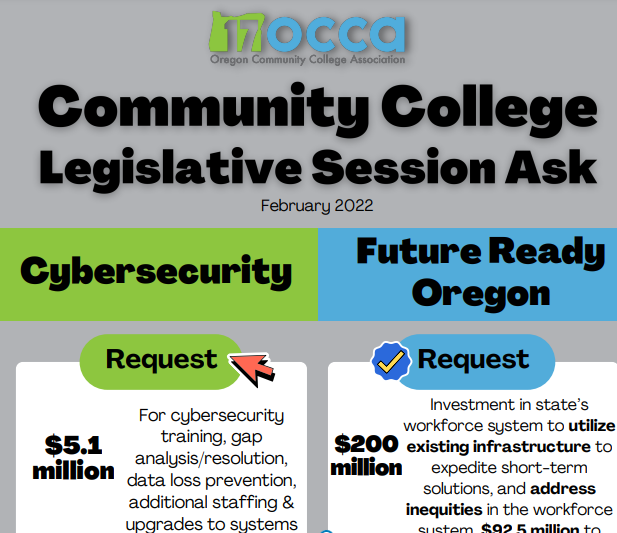
Governor Kate Brown has proposed a workforce bill (SB 1545) that will provide substantial new resources, including:
* Funding earmarked for Career Pathways programs at community colleges and
* Grants available to community colleges for educational programs in: healthcare, manufacturing, and construction
See flyer below for a brief explanation of the bill.
You may wish to consider taking action by sending an automated letter to advocate for the passage of this bill, which will bring much needed funding to community colleges. The legislative session is short and ends in just a few weeks, and it takes just one minute to send your support.
Please find details below on a new MOA and Economic Reopener bargaining.
MOA on Part-time Faculty Compensation for Specific Committees
A new agreement between LCCEA and LCC provides compensation at the rate of two hours pay for every one hour of meeting attendance for specific committees for part-time faculty. (Link.) The additional hour is provided to account for committee work outside of committee meeting time.
These committees are:
Academic Program Review Oversight Committee and associated APR committees
Academic Requirements Review Committee
Curriculum Committee
Institutional Effectiveness Committee
Safety Committee
Faculty Professional Development Oversight, Professional Activities, and Faculty Inquiry Group committees
This compensation is similar to compensation for part-time faculty serving on governance councils and is provided in addition to regular inservice hours allotted to part-time faculty.
Economic Reopener Negotiations
Your LCCEA Bargaining Team met with College representatives last Thursday for preliminary discussions about the economic reopener bargaining, which will cover economics for July 1, 2022 through June 30, 2024 as well as non-economic issues.
Thus far, discussions have been limited to ground rules for the negotiations (e.g. frequency of meetings, etc.). The College has not yet responded as to whether a notetaker will be provided nor made a commitment regarding when they will be ready to exchange proposals with LCCEA. We look forward to resolving these questions so that we may move forward with negotiations on behalf of the faculty.
I hope your winter term is going as smoothly as possible, thus far.
I’m writing with a number of important, brief updates for all faculty regarding: COVID safety this term, concealed weapons prohibition on campus, Minimum Qualifications and Instructor Certification procedures, bargaining, contracted faculty searches, program suspension recommendations, college budget, LCC strategic plan, All Faculty Survey results, and the new Lane County Education Workers alliance.
COVID Safety and Student Attendance This Term
It is likely that there will be an opportunity for faculty to choose to move courses to remote format (with dean approval) due to high rates of student absences and the current COVID surge. Please keep an eye on email for updates.
Concerns or Safety Issues Reporting Form — Given both the increase in on campus instruction and the surge in COVID cases, please use this form to report to LCCEA: questions, concerns, or COVID-safety issues related to the Winter 2022 classes and services on campus. Please also use this form to share student attendance patterns in your in-person classes that may be impacted by the current COVID surge and/or stories related to challenges to your faculty work, workload, and impacts to student learning. LCCEA is collecting this information in order to support and advocate on behalf of faculty. Faculty are also encouraged to submit requests for resolution of safety issues by email to the LCC COVID compliance manager, Dawn Barth at: covidcompliance@lanecc.edu. In addition, faculty are advised to ask their dean for locations of needed supplies (e.g. masks, sanitizer, disinfectant spray, etc.)
Concealed Weapons Prohibited on Campus
The Board of Education adopted a new policy that expands the prohibition of firearms on campus such that concealed weapons are now also prohibited even if a person has a concealed weapons permit. The policy, now possible after legislation coming out of the 2021 session that allows school boards to ban concealed weapons, replaces the longstanding policy prohibiting firearms on campus but which still allowed concealed weapons in the past.
Minimum Qualifications and Instructor Certification Procedures
As previously reported, Academic and Student Affairs (ASA) published new procedures for Minimum Qualifications and Instructor Certification in late September. These procedures are inconsistent with the faculty contract and also represent unilateral changes to mandatory subjects of bargaining (issues about which negotiations are legally required). An analysis of the procedures by the LCCEA Executive Council and Grievance Team as well as legal counsel indicates that the procedures: reduce the role of faculty in determining the minimum qualifications for their discipline and also interfere with existing contract language protecting job security and assignment rights for both part-time and contracted faculty. After several months of communications by OEA-appointed legal counsel, the College has agreed to meet to negotiate and to follow the contractual grievance procedure for any outstanding contractual issues after bargaining is complete. In the meantime, please notify LCCEA immediately if your certifications are under review and/or if any certifications for course(s) or other faculty work are removed.
Bargaining
New Agreement Reached in December
In case you missed it at the very end of finals week in Fall, your LCCEA Bargaining Team reached an agreement over the impacts of SB 551. The new MOA provides substantial gains for faculty, including: increases to college contributions for part-time faculty family insurance (i.e. any tier above employee only), updates to expand eligibility for part-time faculty insurance so that faculty do not unnecessarily lose insurance for one term, paid non-instructional time for both contracted and part-time faculty, a new Justice, Diversity, Equity and Inclusion Faculty Fellowship with at least two contracted positions each year, as well as funding for FPD for a new BIPOC faculty mentorship program and curriculum development funding to build student understanding of equity, inclusion, and systemic oppression. LCCEA is working collaboratively with HR to implement numerous provisions of the MOA.
Part-time Faculty with Insurance from Two Oregon Public Institutions of Higher Education
Part-time faculty who also teach at other public institutions of higher education in Oregon and receive insurance both at LCC and the other institution will have the opportunity to opt-out of designating LCC as their home institution for the purpose of insurance. Because LCC-provided insurance for part-time faculty is excellent, and our contract provides that the College pays 100% of insurance for eligible part-time faculty with employee-only insurance, we anticipate few, if any, faculty will wish to opt-out. Opting-out is not relevant for faculty who do not teach at other public colleges or universities in Oregon. More communications from HR will be forthcoming. In the meantime, please do not hesitate to contact LCCEA with questions.
Economic Reopener
Negotiations are scheduled to begin by the end of this month for the economic reopener of our contract, which will cover the 2022-2024 years. In addition to economics, each party may bring up to three non-economics. Please join me in thanking LCCEA Bargaining Team members, Kelly Collins, Joseph Colton, and Nancy Wood, for their dedication and commitment to representing faculty interests as we move from one negotiation to the next!
Contracted Faculty Searches
In addition to filling eight extra contracted faculty positions (no less than sixteen total) for the 2022-2023 year, one outcome of the grievance resolution over insufficient hiring of full-time faculty positions for this year is public posting of the status of all contracted searches. You will find current searches and details about their status posted publicly on the HR website and linked from the HR “Employment” page. This College will maintain and update this list this year and into the future so that information regarding the status of all contracted faculty positions will be available publicly.
Program Suspension and Modification Recommendations Go to Board This Wednesday
Programs Under Review
As reported last term, Academic and Student Affairs (ASA) has been reviewing three programs: Culinary, Manufacturing, and Hotel, Restaurant, and Tourism Management (HRTM) and is now recommending that the Board of Education take the following actions this Wednesday, January 12.
Culinary:
Replace the current Associate’s degree with two career pathways certificates housed within an “umbrella” one-year certificate. LCCEA greatly appreciates the leadership of the administration in working collaboratively with faculty in both Culinary and Career Pathways to ensure that, through these changes, the college will maintain access and promote equity for the diverse student population served by the program.
Manufacturing:
Replace the current Associate’s degrees with two short-term certificates and develop an advanced manufacturing/ mechatronics/ automation technology AAS.
Hotel, Restaurant, and Tourism Management (HRTM)
Eliminate the program entirely. The HRTM program was recently redesigned with a new two-year degree approved last Spring. However, the Administration asked the program during summer to create a one-year certificate to replace the newly approved two-year degree. Since that time, however, ASA has advised the program that they are disallowed from presenting a new one-year certificate proposal to the Curriculum Committee. Industry leaders from Travel Lane County, the Eugene Hilton, the Graduate Hotel, and the Oregon Restaurant and Lodging Association have advocated to maintain the program, citing, for example, the 11,000 jobs in the tourism industry in Lane County as of 2019 and the high demand for LCC program graduates.
If the Board proceeds with the Administration’s recommended actions, it is likely that one faculty member will be impacted.
College Budget and Disinvestment in the College Mission
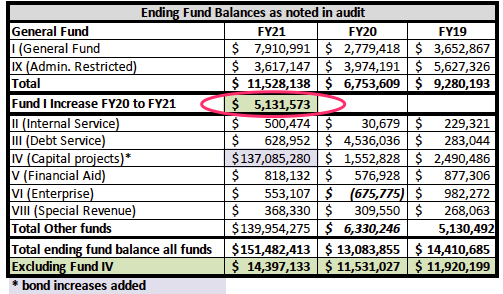
The College’s FY21 (Fiscal Year 2021: July 2020-June 2021) budget audit was published and indicates much better fiscal stability. Federal pandemic relief funding was applied retroactively to account for lost revenue and pandemic-related expenses from FY21. This resulted in increases to the ending fund balances of several funds. In particular, Fund I (the General Fund) now has an ending balance of nearly $8M, an increase of more than $5M, ensuring that the College is much more stable than a year ago. Please see summary of ending fund balances (dollars remaining in each fund at the end of the fiscal year) below.
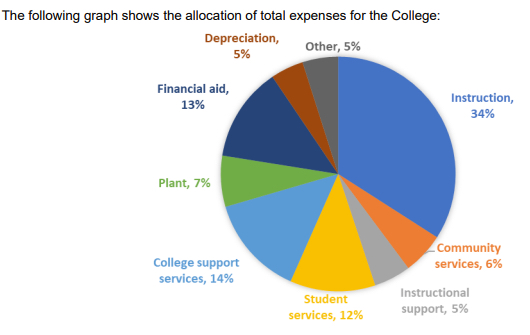
However, persistent issues remain, including the lack of sufficient investment in the instructional and student services mission. Please see graph below, which is copied and pasted from the official budget audit document. Instruction, which includes all expenses related to instructional departments (i.e. faculty, management, classified, materials and services) comprises only 34% of total annual expenses. Furthermore, instruction, together with student services at 12%, comprise only 46% of total expenses.
Strategic Plan
The Board of Education approved the new LCC strategic plan at their December 15 meeting. However, the Administration presented the strategic plan draft to the Board of Education without a vote or approval by College Council, which is required by the College Council charter and the LCC shared governance system. Instead, College Council had been asked to forward feedback on the plan to the Board, compiling input from multiple shared governance councils and constituencies, some of which called an extra meeting the day before Thanksgiving or dedicated substantial meeting time to formulate thoughtful feedback. None of the feedback, including College Council’s own approved feedback, was incorporated into the draft forwarded to the Board. Hence, the plan has not been vetted through LCC’s shared governance system and does not account for the voluminous feedback provided by stakeholder groups including: Faculty Council, Infrastructure Council, College Council, LCCEA, among others.
All Faculty Survey Brief Results
Thank you to the 249 faculty who participated in the All-Faculty Survey in November. Your LCCEA Bargaining Team has been analyzing results in preparation for the upcoming negotiations in order to best represent faculty interests. In the meantime, please find below a summary of some of the results about faculty working and student learning conditions on campus.
Workload and Uncompensated Time
74.1% of faculty respondents work more than their assigned and compensated FTE with 34.3% working 21% or more over their assigned and compensated FTE
96.7% work some evenings or weekends (outside of regularly assigned times) with 84.2% working evenings and/or weekends at least half of the weeks each term.
Necessity and basic needs
36% of part-time faculty who are not retired and 8.3% of full-time faculty reported having relied on government assistance while working as faculty at LCC.
10.2% of part-time faculty who are not retired experienced food insecurity, 2.8% of contracted faculty experienced food insecurity during the last year.
One faculty member reported experiencing houselessness during the last year.
Impacts on Faculty Working and Student Learning Conditions
97.6% strongly agree or agree that they are committed to serving students.
62% of full-time faculty and 55% of part-time faculty who are not retired report that stress from their job affects their life outside of work.
41% of full-time faculty and 29% of part-time faculty have considered seeking a job elsewhere due to working conditions at LCC.
19.1% report not having office space at LCC that allows them to meet privately with students.
20.6% report not having access to the technology needed to do their job.
19.4% report that classrooms and instructional spaces do not allow them to serve students well.
Faculty Morale, Appreciation, and College Leadership
31% of full-time faculty rate their morale high while 39% rate their morale low with 31% neutral.
73.1% of full-time faculty feel valued by their faculty colleagues while only 29.9% feel valued by administrators.
68% of full-time faculty have low or lowest confidence in the administration’s inclusive decision making that values stakeholder input with only 11% reporting high or highest confidence and 21% neutral.
69% of full-time faculty have low or lowest confidence in the administration’s budget allocations to fulfill the college mission with 11% reporting high or highest confidence and 20% neutral.
54% of full-time faculty disagree or strongly disagree that senior leadership at LCC cares about their concerns with 32% neutral and 14% agreeing.
Results indicate similar patterns of concerns among faculty regarding: staffing of faculty positions, administration’s transparent and accurate communication, among others.
Lane County Education Workers
LCCEA is proud to stand in solidarity with our colleagues across the education continuum as a founding member of the new Lane County Education Workers – an alliance of unions representing education workers in Lane County from pre-K through university. We are committed to providing students at all levels with a rich, vibrant learning experience. To achieve this objective, Lane County Education Workers (LCEW) intends to be a strong, unified, and active voice on behalf of public education, our students, and our communities. We pledge to work with others who share these commitments and plan to advance them through mutual support, coordinated advocacy, and collective action. Members include: Eugene Education Association, Graduate Teaching Fellows Federation, Lane Community College Education Association, Lane Community College Employees Federation, Oregon School Employees Association Eugene Chapter 1, Service Employees International Union Local 503, Springfield Education Association (Springfield School District), and United Academics (University of Oregon). Please see this announcement for more details.
Dates for Your Calendar
February 18-19, OEA-PAC Convention (Virtual) Individuals who contribute to OEA-PAC may register to attend this important event where delegates will vote to select political candidates that OEA will endorse for US Congress, Oregon Governor, and more. (As a reminder, OEA member union dues do not support political contributions, only education policies. For this reason the OEA-PAC Convention is only open to individuals who contribute directly to the PAC.)
April 29-30, OEA Representative Assembly is the event where delegates from OEA-affiliated local unions vote to help formulate the directions for OEA for the next year, including legislative objectives, by-laws changes, and budget adoption. Faculty who are LCCEA members are invited to consider nominating themselves and/or a colleague to attend as a delegate. More information on the nomination process will be provided by LCCEA Secretary, Aryn Bartley, after the end of this month.
Best wishes that the rest of the week goes as smoothly as possible, especially given the dramatic COVID surge and impacts to in-person instruction and services.