LCCEA President’s Update May 5, 2021

LCC Faculty Colleagues,

I’m writing with a number updates on behalf of LCCEA regarding: bargaining, College communications about campus COVID cases, shared governance redesign, an important grievance resolution, May election endorsements, OEA updates, legislative updates, and compensation increases for next year.

Thank you to the more than 300 faculty members who participated in the LCCEA All-Faculty survey in April! Your voice is critical to ensuring LCCEA best represents faculty interests in negotiations regarding both hyflex* instruction and reopening as the campus transitions to more in-person offerings.

Summer Reopening MOA

Given that the pandemic continues to impact our campus and larger community, your LCCEA Bargaining Team (Kelly Collins, Adrienne Mitchell, and Nancy Wood) has proposed an extension of the current COVID-Working Conditions MOA for Summer term in order to protect the safety of faculty and provide adequate compensation for faculty working in Summer. Please see the draft below and look for an update to all faculty once we have received a response from the College.

Bargaining regarding impacts of “hyflex” teaching

Negotiations over the impacts of “hyflex,” streaming instruction are scheduled to begin today (Monday, May 5). Your LCCEA Bargaining Team had an initial meeting with the College on April 23 in order to gather information about the plan for a proposed hyflex* pilot. *Hyflex teaching is a modality that is a distinct version of hybrid courses. Like hybrid courses, the hyflex modality offers some face-to-face instructional time with the remainder of the course online. However, for the face-to-face time in hyflex courses, instructors teach live in a classroom with some students physically present while simultaneously teaching some students who are off campus via Zoom for the “in-person” portion of the course. Students decide on a day-to-day basis whether to attend in person or via Zoom.

Fall Reopening

Your LCCEA Bargaining Team will also negotiate over impacts to working conditions for Fall in order to best protect faculty interests as more instruction and services re-open in-person. We anticipate these negotiations will begin after an agreement is finalized for Summer term and revised OHA and CDC guidelines are announced.

Please keep an eye out for updates from your LCCEA Bargaining Team on negotiations regarding: Summer, hyflex, and Fall reopening.

College Communications Regarding COVID cases

As many faculty members may be aware from recent announcements and forums, LCC is not providing notice to employees and students when they have been physically present at a campus activity with a person who has tested positive for COVID-19 unless Lane County Public Health determines that there was “close contact,” currently defined as less than 6’ social distancing for more than 15 minutes over a 24-hour period. This means, for instance, that if a student attending in-person tests positive but only attended classes where there was at least 6’ distancing in place with masks, the faculty member(s) and other students will not receive any notice. In the LCCEA all-faculty survey, faculty expressed overwhelming support for requiring notice in such circumstances, and you will see in the Summer MOA proposal attached that your Bargaining Team has included a requirement for such notice, and your LCCEA representatives will advocate for more transparent communication that also protects individual health privacy. For reference, case counts among students and employees can be viewed on the LCC COVID  dashboard .

Shared Governance Redesign

The LCC shared governance system has been undergoing a redesign process for several years, and the College Council approved the Governance Implementation Team’s recommendations and work plan at the April meeting. Changes include: making Faculty Council a formal council of the governance system as well as implementing a notice and comment process for new and revised policies. In addition, you will see that one of the recommendations is to “Support adequate compensation/release time for governance participants,” which will also be the subject of negotiations on behalf of faculty. Overall, these changes should promote greater transparency and help elevate faculty voices through formal inclusion of Faculty Council, which retains academic and grading policies within its purview.

The extent to which faculty voices and Faculty Council decisions will be honored is unclear. For example, at the most recent meeting, Faculty Council formed a Taskforce, which includes faculty from both Academic Technology and instructional departments, to revise definitions for teaching modalities (e.g. online, hybrid, etc). However, while the Taskforce is still conducting its work, the Provost announced modality definitions in an email to all employees. (Some members of Faculty Council also expressed concerns about the announced definitions, including that they do not account for the option of proctored testing for online courses. The need for proctored testing was reflected in the LCCEA All-Faculty survey results as well.)

Shared governance will only have efficacy and meaning if the Administration honors and respects the value and voice of faculty.

Grievance Resolution

Your LCCEA Grievance Team recently reached an important resolution with the College. A group of part-time faculty had been hired to do instructional work beginning in Fall 2020 without being properly classified as faculty, resulting in: no consideration of education or experience in salary placement, insufficient compensation below contractual salary schedule rates, and lack of rights and benefits under the contract. The resolution provides that the affected faculty are now retroactively correctly classified as part-time faculty, receiving full retroactive compensation and contractual benefits to the date of hire, including the ability to qualify for healthcare and part-time seniority over time.

Oregon Education Association Updates

Congratulations to Enrique Farrera, who was elected to serve as Vice President of the OEA, our statewide union. Enrique is a community college member from Clackamas CC, who will help amplify the voice of the community college sector as a statewide leader.

The delegates to the statewide OEA Representative Assembly voted to approve a by-laws change to make dues for part-time faculty more affordable and equitable. OEA dues for PT faculty will be assessed based on salary rather than FTE beginning in Fall 2021. Many PT faculty will see a reduction in OEA dues deductions as a result of this change.

Legislative Advocacy

With the Oregon legislative session in full swing, your LCCEA and OEA representatives are engaged in advocacy around a number of goals in support of community college members.

These include: support for increased funding for the need-based Oregon Opportunity grant for students, advocacy for part-time faculty healthcare statewide, and increased funding for the CCSF (Community College Support Fund). Thank you to Welding faculty member, Doug Ford (pictured below), for testifying before the Joint Ways and Means Committee in support of $702M CCSF funding for the next biennium. Thank you also to Nursing Faculty member, Jeremy Kaufman, for additional testimony provided to the Ways and Means! You will find Doug’s testimonyJeremy’s testimony, and LCCEA testimony on the Oregon Legislature’s website for the hearing.

IMG_2197.jpg

May Elections and LCCEA Endorsements

LCCEA proudly endorses Austin Folnagy (Zone 4), Holli Johnson (Zone 1), and Steve Mital (Zone 5) for LCC Board of Education as well as Rose Wilde for Lane ESD Board for the upcoming election in May. Thank you to LCCEA Legislative Action Committee and Executive Council members for conducing the interviews and endorsement process.

In addition, LCCEA stands in solidarity with our colleagues in Eugene 4j in support of EEA-Endorsed candidates for the 4j school board: Tom Di Liberto, Laural O’Rourke, and Maya Rabasa and also supports Ashley Espinosa for Bethel Board. Ballots are due by May 18. 

Compensation Increases for 2021-2022

A reminder to all faculty – through the overwhelming organizing efforts and support of faculty in Fall 2019, salary schedule increases are coming for the 2021-2022 year as provided in our contract. Compensation will increase for all faculty as follows.

For part-time faculty:

Beginning in July, 1.5% COLA, plus 3% pay parity adjustment**, plus full steps (3.75%) as earned. For faculty at the top of the salary schedule, one half-step (1.875%) will be added, and the bottom step will be dropped. Total increases for step-eligible PT faculty: 8.25%. Total increases for PT faculty already at the top: 6.375%. **Pay parity adjustments make incremental change toward pay equity for part-time faculty; a long-term goal of the Association is to address the systemic inequity that affects part-time faculty at LCC and in community colleges nationwide.

For contracted (e.g. full-time) faculty:

First, in July, salaries for contracted faculty affected by furloughs this year will return to normal 2020-2021 levels. (2020-2021 salaries were reduced for ten months only to account for furlough days. Reductions were largely offset by tax-free reimbursements by Workshare through an agreement that moved six paid course preparation days to Summer 2020.)

Then, beginning in July for those working in Summer or September for those not working Summer: 1.5% COLA, plus full steps (3.75%). For faculty already at the top of the salary schedule, one half-step (1.875%) will be added, and the bottom step will be dropped. Total increases for step-eligible contracted faculty: 5.25% and for FT faculty already at the top: 3.375%. (Please note: the increase from current paychecks for faculty affected by furloughs will be 9.93% for step-eligible faculty and 7.92% for faculty already at the top.)

Coming up today, this month, and beyond:

* Today at 4:00 p.m, Know Your Contract Info Session: Calculating Instructional Workload, hosted by your LCCEA Grievance Team Register here. 

* May 7 and June 11: Contracted faculty furlough days; these are non-working, non-instructional days

* LCCEA Meeting, later this month, date TBD

* LCCEA Elections, the Treasurer and five Vice President positions will be up for election later this month

* June 10: last day of the Spring term work year

* September 21: first day of the contracted faculty work year for 21-22

* September 23: All campus in-service and All-Faculty LCCEA meeting

* September 27: first day of Fall term

My best,

Adrienne

Posted in General | Leave a comment

Support Funding Healthcare for Part-Time Faculty Statewide

Colleagues, 
Let your voice be heard! Faculty may take action to support funding healthcare for part-time faculty statewide by sending an automatic letter to your legislators at: https://actionnetwork.org/letters/part-time-faculty-deserve-affordable-healthcare/ 

It only takes one minute, and it is possible to modify the letter if desired. Faculty may wish to also include a note about the need for $702 Million for the Community College Support Fund, the amount needed to maintain “current service levels” at community colleges throughout Oregon.


While many part-time faculty at LCC receive healthcare benefits through our contract, most community colleges in OR provide no benefits to part-time faculty. Faculty are encouraged to stand in solidarity with our part-time colleagues throughout the state. This bill, if enacted, will also reduce pressure on the LCC budget, and savings will be reserved for labor relations and negotiated for the benefit of faculty.
Your LCCEA Legislative Action Representatives

Website: https://lccea.org/Instagram:  https://www.instagram.com/lccea/Facebook: https://www.facebook.com/LCCEAAction/Twitter: https://twitter.com/college_lane

Posted in General | Leave a comment

LCCEA President Update April 7, 2021

LCC Faculty Colleagues,

I hope your term is going well thus far.

I’m writing on a number of topics including atrocious, increasing Anti-Asian violence as well as local and statewide updates regarding: reopening, “hyflex” modality, program “sustainability analysis,” one retrenchment, the college budget and federal funding, state funding and legislation, LCCEA endorsements for Board of Education, the separation incentive, and more.

Increasing Bias and Hate-Based Violence Against Asians and Asian Americans

Thank you to Anne McGrail and many colleagues who have brought forward concerns about increasing Anti-Asian sentiment and violence for public discussion among faculty after the deadly shootings in Atlanta. Horrifyingly, such acts continue. (See a recent New York Times analysis.) It is paramount that we condemn all acts of hate-based violence as well as the underlying biases they evince and recognize that the impacts of hate-based violence are broad, complex and extend to the entire community to which survivors belong. LCCEA stands in solidarity with our Asian and Asian American colleagues, students, and community members and asks each of you to do the same and to reaffirm our commitment to building a supportive community and just society through our work as faculty.

Local and Statewide Updates:

Reopening and “hyflex” modality

The College has announced a plan to offer approximately 50% of instruction face-to-face in Fall term, which diverges from typical pre-pandemic offerings when approximately 75% of instruction took place in person. Given that the current COVID-19 Working Conditions MOA expires at the end of this term, LCCEA will negotiate provisions regarding safety and working conditions impacts for the Summer term interim.

In addition, your LCCEA Bargaining Team will conduct a survey to assess faculty interests regarding safety, working conditions, workload, and compensation pertaining to substantial reopening planned for Fall as well as hyflex* teaching. Please keep an eye out for the survey — your participation and your voice are important to help ensure LCCEA can best represent faculty interests. Thank you to Kelly Collins and Nancy Wood for their service on the Bargaining Team.

* Provost Jarrell has announced the introduction of a new modality, “hyflex.” Hyflex teaching is a modality that is a distinct version of hybrid courses. Like hybrid courses, the hyflex modality offers some face-to-face instructional time with the remainder of the course online. However, for the face-to-face time in hyflex courses, instructors teach live in a classroom with some students physically present while simultaneously teaching some students who are off campus via Zoom for the “in-person” portion of the course

“Program Sustainability” Update and Retrenchment Notice

As noted in my all-faculty email in Winter term, the College Administration has been conducting a review of programs and services to determine their long-term sustainability. As of January, the Administration had identified a preliminary list of programs that were undergoing consideration for possible elimination, including the following instructional programs: Aviation Maintenance, Culinary, Flight Technology, and Hospitality, as well as the following services or non-academic programs: Printing and Graphics, Senior Companion, and Specialized Support Services (S3). Academic Learning Skills had also been identified for possible restructuring or reorganization, and Manufacturing was identified for curricular revision.

As of early February, the Administration determined that Flight Technology and Aviation Maintenance would not be considered for elimination this Spring. Also in early February, the Administration scheduled meetings with the faculty in both Culinary and in Hospitality to inform them that their programs had been identified as programs for possible recommendation for elimination. On a positive note, after hearing overwhelming community support and advocacy for the programs, the Administration later removed both Culinary and Hospitality from the list of programs that would be considered for possible recommended elimination as of the end of February. Thank you to LCCEA Action Team Co-Chairs, Wendy Simmons and Paula Thonney, as well as to numerous faculty advocates for their successful organizing effort.

However, the Administration did provide official notice to LCCEA of intent to retrench (i.e. lay off) one full-time non-instructional contracted faculty position, affected by proposed departmental reorganization. LCCEA and Administration representatives have met to discuss alternatives consistent with Article 10.2. LCCEA has advocated that this proposed reorganization be presented to the Board of Education publicly in accordance with Board Policy and the role of the Board in decision making.

In addition, this week the Administration has “announced” more detailed plans for continued “sustainability” analysis. The “announcement” was not actually an announcement but rather has been made public by posting documents this week on the LCC BoardDocs website for the Board of Education work session tonight. In the documents, the Administration again identifies the following programs: Academic Learning Skills, Aviation Academy, including both Flight Tech and Aviation Maintenance, Culinary Arts, Hospitality, Manufacturing, and Specialized Support Services (S3).

The Administration’s recommendations for each instructional program are to continue the analysis next year for decision-making in Spring 2022 as follows:

Academic Learning Skills: “review the need for a separate ALS department… should the department be eliminated; current ALS faculty may need to be ‘transferred’ to other departments… Should retrenchment be necessary, the College will work within the requirements of the [contract].”

Aviation Maintenance: “Complete Program Review … review staffing levels … Should retrenchment be necessary, the College will work within the requirements of the [contract]”

Flight Technology: “Consider moving … to the general fund … continue to regularly assess program outcomes.”

Culinary: “Continue to support the CA program in [its] new design…”

Hospitality (Hotel, Restaurant, and Tourism Management): “Eliminate the HRTM AAS* and restructure this program to a 1-year Hospitality certificate and a stackable Career Pathways Certificate.” 

[Please note: the current (new) HRTM AAS was just approved by the Board of Education in March and is on the consent agenda at the HECC (Oregon’s Higher Education Coordinating Commission) for tomorrow. After requiring the sole remaining contracted faculty member in the program to develop a new version of the HRTM AAS, the Administration is now recommending eliminating the same new HRTM AAS next year that was just approved last month, replacing it with certificate programs.]

Manufacturing: “Eliminate the current AAS degrees and restructure this program into stackable, shorter certificates… [Utilize grant funding to develop] a new Advanced Manufacturing AAS.”

It is important to note that this information is preliminary and that the Board of Education is ultimately responsible for making decisions about program cuts or major substantive changes to programs should any programs be recommended for reduction or elimination in Spring 2022. Please also note that the fiscal data presented about many of the programs are already outdated due to the retirements or other separations of full-time faculty in multiple programs on these documents. The attached reports appear to be the first presentation of this data to the Board of Education and campus community. LCCEA will keep faculty appraised of new developments and opportunities for advocacy should the program “sustainability analysis” continue as planned next year.

As many are aware, among other deleterious effects, cutting instructional programs results in lost revenue, which has sent the college budget into a downward spiral in years past. At this time, however, the fiscal outlook for the College has improved dramatically, making program cuts for financial reasons entirely unnecessary. (Details below.)

Federal Relief Funding, State Funding, and the College Budget

Excellent news on the budget front –

While Governor Brown had proposed keeping the CCSF (Community College Support Fund) flat at $641M for 2021-23, the legislature’s Ways and Means Co-Chairs have initially recommended $673M, a 5% increase, which would result in approximately $1.4M in additional funding each year for LCC. While this falls short of the $703M requested by OEA, OCCA, and other statewide partners, it is a very positive development especially relatively early in the legislative session. The CCSF allocation will likely be finalized in late May or June and could increase more.

In addition, LCC will receive substantial relief funds from the federal government, which will also directly benefit students. 

CARES Act (March 2020): $3M for LCC with $1.5M of that sum dedicated to emergency grants for students.

CRRSAA Allocations (December 2020): $8.9M for LCC with $1.5M of that sum dedicated to emergency grants for students.  

American Rescue Act Allocations for Higher Ed (March 2021): $15.7M for LCC with $7.9M of that sum reserved for students 

Total: $27.6 M, including $10.9M for students and $16.7M for institutional use

This funding far exceeds lost revenue due to enrollment declines (estimated at approx. $2.5M for this fiscal year) and increased expenses from the pandemic. The federal grants will also help restore the general fund ending fund balance and set LCC back on a path toward fiscal sustainability. (For context, the total projected annual expenditures in Funds I (general fund) and IX for next year amount to $90.9M.)  

Oregon Legislative Updates

In other promising news, the twin Senate and House statewide part-time faculty healthcare bills have both passed out of committee and on to Ways and Means.  If they pass, Oregon will establish and make appropriations to a “first-in-the-nation” statewide part-time faculty healthcare fund, providing much-needed affordable healthcare to part-time faculty throughout the state. While the LCCEA contract is one of the few community colleges in the state that provides healthcare to part-time faculty, the additional positive impact for LCC if the bills are enacted includes mitigating pressure on the LCC budget and providing that savings be utilized for the purpose of labor relations (i.e. negotiated for the benefit of faculty). For more information, please read details on the bill and LCCEA testimony. Please keep an eye out for more details on how to advocate for part-time faculty healthcare from our statewide union, OEA.

Congratulations to the LCC Torch Student Newspaper!

Congratulations to the LCC Torch on winning the Oregon Education Association News Media Award for thorough reporting on LCC-LCCEA contract negotiations in Fall 2019, including coverage of part-time faculty pay inequity and declining full-time faculty positions. Editor-in-chief David Galbreath and Faculty Advisor Charlie Deitz participated in a virtual ceremony to accept the award.

DSCF0500.jpg

DSCF0484.jpg

LCCEA Endorsements

LCCEA proudly endorses Austin Folnagy and Holli Johnson for LCC Board of Education for the upcoming election in May. We are very fortunate to have such highly qualified candidates running for the Board. Learn more about Austin and about Holli. Thank you to LCCEA Legislative Action Chair, Cybele Higgins, for coordinating the endorsement process.

In addition, Lane ESD Candidate, Rose Wilde, invites LCC faculty to attend a virtual house party hosted by LCC faculty member (and Lane ESD Board member)Leonora Kent on April 11th at 2pm, for Lane ESD candidates and for Holli Johnson, who is running for LCC Board.  Faculty may register here.

Shout Out

Please join me in thanking Christina Howard as she continues her incredible work as Grievance Chair in developing a team approach to protecting contractual rights for all faculty and ensuring faculty are well represented.

Separation Incentive—deadline this Friday, April 9

A quick reminder for contracted faculty considering the separation incentive – the deadline to submit paperwork to Human Resources is this Friday, April 9. You will find the details of the separation incentive on the MOA.

Coming Up This Term for All Faculty:

LCCEA All-Faculty Survey, watch your email in-box for a link in the next few days

Know Your Contract Info Session on Workload, Date TBD

Coming Up This Term for LCCEA Members:

LCCEA Meeting, mid-May, date TBD

LCCEA Elections, late May, dates TBD — the Treasurer and five Vice President positions will be up for election

If you are unsure of your membership status, please contact LCCEA Membership Chair, Wendy Simmons. In case you missed it, you may enjoy watching the delightful faculty “Show and Tell” video organized by Wendy and the Membership Committee in winter term.

Thank you for the work you do today and every day.

My best,

Adrienne

Posted in General | Leave a comment

Chris Crosthwaite Celebration of Life March 7 at 3:30 pm on Zoom

Celebration of Life poster
For more information or to RSVP go to https://www.chefchris.life/
Posted in General | Leave a comment

LCCEA President’s Update Jan 26 2021

LCC Faculty Colleagues,

I hope your term is going well thus far.

I’m writing with updates regarding: contracted faculty positions, vaccines, programs under consideration for possible reduction, community college funding and college budget, college spending priorities, legislative update, a virtual “fireside chat” for members with Dr. Fauci, and more.

Contracted Faculty Positions and Possible Retirement Incentive

As you may recall, the College and faculty agreed last June in the Workshare MOA that the minimum number of contracted faculty positions for the 20-21 academic year only would be 201. However, the College did not hire sufficient full-time faculty to fulfill its contractual obligations. After discussions over the term, the Administration agreed at the very end of Fall to post an additional four positions for immediate hire and return one position that had temporarily been converted into a management position to faculty in order to meet the contract requirements. 

As for 2021-22, we do not yet know the number of contracted faculty because that will be determined by a formula based on faculty FTE later this term. It is clear that, after retirements, there will be fewer contracted faculty next year. ASA has provided a preliminary ranking to plan for hires for next year.

On a related note, LCCEA is conducting a survey of contracted faculty considering retirement in order to best represent faculty interests in possible negotiations over a retirement incentive. If you are a contracted (i.e. full-time) faculty member considering retirement, please complete the survey at: https://forms.gle/G8HH1DLTBHzBdHZo8 . The survey will also help inform decisions about the number of full-time positions the college will post for the 21-22 year.

Vaccines

The vaccine rollout in Oregon continues to be an ever-changing landscape. LCCEA and our colleagues from the OEA Community College Council, which includes 16 other community college local unions, have advocated that community college faculty and staff be included in the priority category 1B, consistent with the placement 20 other states have already made in accordance with CDC guidelines. This would mean that higher education employees in Oregon would be eligible to receive vaccines after healthcare workers, vulnerable populations, and after all adults 65 and older. This would not mean a placement with K12 in Oregon because Governor Brown has created a unique prioritization for K12 and early childhood educators ahead of other groups. While messages from both OEA and our College may have been confusing on this point, a 1B prioritization for higher ed consistent with the CDC would allow eligible community college faculty and staff to receive vaccines only after vulnerable populations and all 65 and older adults and would not coincide with the early vaccination time for K12.

In addition, the LCC Board of Education resolution aligns in advocating for a 1B prioritization for community college employees. The final version approved by the Board on Wednesday, January 20 can be found at: https://drive.google.com/file/d/1rSh49nZPdtZmFFYp_CwuFcUCrWMPnyj1/view?usp=sharing  Please note: this resolution adopted by the Board differs from a previous draft that was sent out in the campus Titan Times communication.

Governor Brown stated verbally at a meeting I attended last week that higher ed will be in 1B, and one local legislator has confirmed that will likely be the case. However, this placement, which is consistent with the CDC guidelines, has not been formally confirmed or announced. If it does come to fruition, it is possible that community college employees would be eligible to begin receiving vaccines sometime in March or April.

The fundamental purpose of the CDC prioritization is to protect public health and ensure widespread vaccination of the U.S population as quickly as possible to protect not only individuals, but also the greater community. At LCC, we have a growing number of programs and services with some in-person activities, which extends beyond Health Professions, CTE programs in Advanced Technology, the Aviation Academy at our airport campus, to Music, Dance, some Science and Engineering labs, Athletics, among many other programs and services. You can find the growing number of programs and services with in-person operations at: https://www.lanecc.edu/covid19/plans-reopening-safely

In addition, there have been 47 known* COVID cases among LCC students and employees to date, including 12 cases associated with employees or students attending LCC in-person. Track cumulative cases among LCC students and employees at: https://docs.google.com/document/d/11er8uwDeMznqv7ar1VSrE6rc6kZA9IsdhTD8w_08q7M/edit

Finally, as a part of the broader group of community colleges statewide, it is important to recognize that while many of us as faculty at LCC have had the luxury of working from home without risk of exposure on campus, many faculty and staff on our campus and others continue to work in-person. In addition, two community colleges in our system – Klamath CC and Treasure Valley CC – have been 100% face-to-face since September.

Program Sustainability and Timeline

As noted in my all-faculty email in December and announced by Provost Jarrell last week, the College is conducting a review of programs and services to determine their long-term sustainability. The Administration has identified a preliminary list of programs that are  undergoing consideration for possible elimination, including the following instructional programs: Academic Learning Skills**, Aviation Maintenance, Culinary, Flight Technology, and Hospitality, as well as the following services or non-academic programs: Printing and Graphics, Senior Companion, and Specialized Support Services (S3). The Administration has also identified a longer list that includes services and departments that may undergo reorganization or restructuring at some point in the future but which are not currently under consideration for possible elimination. It is important to note that this is a preliminary list and that none of these programs have been formally recommended for elimination to the Board of Education, which is ultimately responsible for making decisions about program cuts or major substantive changes to programs.

If any program or service reductions that would result in faculty retrenchments (i.e. layoffs) are proposed, the College is required to provide notice to LCCEA by March 15 and to meet to discuss alternatives. In addition, the College is required to provide official notice to affected individuals by May 1. Given these contractual timelines and the college budget adoption process, it is likely that any budget reductions would be decided no later than the April 21 Board of Education meeting. 

Why academic program reductions or eliminations do not make fiscal sense:

  • The vast majority of programs generate net revenue via tuition and state FTE reimbursement, which not only covers program costs but also supports college operations and all non-instructional college expenses.
  • When programs are eliminated or reduced, revenue from those programs would also be lost, only exacerbating budget deficits and increasing pressure on remaining programs to support the costs of all non-instructional college operations.

Federal Relief Funding, State Funding, and the College Budget

As reported in December, the Governor’s proposed budget maintains the CCSF (Community College Support Fund) at the current level ($641M) for 2021-23 but does not account for inflation. This budget is only the starting place for advocacy as the legislature will ultimately formulate a balanced budget, and the CCSF may increase. Furthermore, the governor has proposed implementing a statewide part-time faculty healthcare fund in the amount of $10M to begin in the second year of the biennium, which would also mitigate pressure on the LCC budget since benefits are provided to eligible part-time faculty under our contract.

In addition, the recent federal COVID relief act (CRRSAA) provides welcome news with $8,943,191 for LCC, which includes $1,507,133 as a minimum amount for aid direct to students, leaving $7,436,058 for institutional use, including to offset tuition losses from enrollment decline during the pandemic, which will help balance the budget. For context, $8.9M is roughly 10% of the general fund budget. (The allocation for LCC is noted on p. 40 of this Dept of Ed file at: https://www2.ed.gov/about/offices/list/ope/314a1allocationtableheerfii.pdf )

This amount is far more than anticipated and more than accounts for all tuition losses from enrollment decline last Spring and this academic year. In short, this funding alone compensates for all budget deficits stemming from the pandemic.

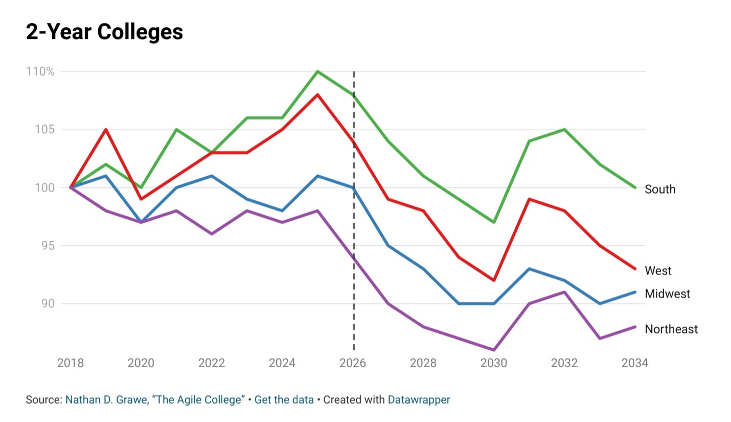
In addition, the Chronicle of Education released a report this month, projecting increased enrollment enrollment at 2-year colleges through 2026 before a decrease due to demographic shifts in the number of college-aged students. Any enrollment increases will increase net revenue. In addition, because LCC has had better enrollment relative to other community colleges in the state over the past couple of years, including during the pandemic, the percentage allocation for LCC from the state support fund will continue to increase, resulting in more funding for LCC. (See graph below on enrollment projections and article at: https://www.chronicle.com/article/how-to-navigate-the-demographic-cliff)

While the one-time funds from the federal government will reduce pressure on LCC, the overall college budget continues to face challenges due to college spending priorities and unresolved systemic issues (e.g. Titan Court apartment building with its deficit and debt) as does the community college system within the state, which remains undervalued and funded at a level that necessitates tuition increases each year statewide. OEA (our statewide union Oregon Education Association), together with OCCA (Oregon Community College Association) and other partners, is advocating for $703M for the 21-23 biennium, which would represent a $2.8M per year increase for Lane.

College Spending Priorities

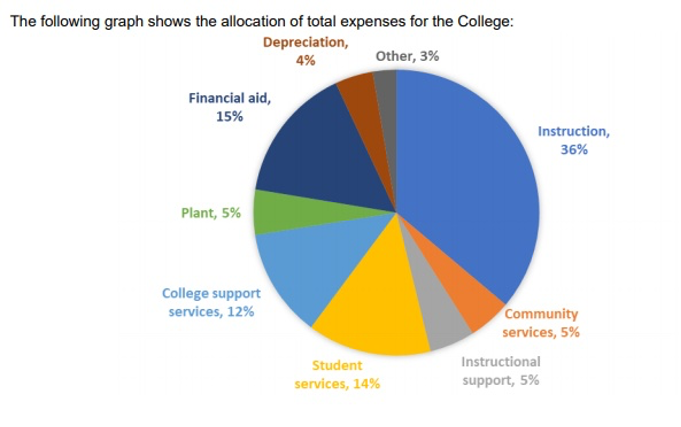
The newly released official LCC FY20 (fiscal year 2020) financial audit statement illustrates college spending with the chart below, which calls into question college spending priorities. As you will see, LCC dedicates 36% of all annual expenses to instruction. (Please note: “Instruction” in this context includes all expenses for instructional departments, including faculty, classified staff, management salaries and benefits as well as materials and services). (See p. 7 at: https://go.boarddocs.com/or/lanecc/Board.nsf/files/BXFUE97BA98E/$file/Lane%20CC%20CAFR%206-30-20.pdf )

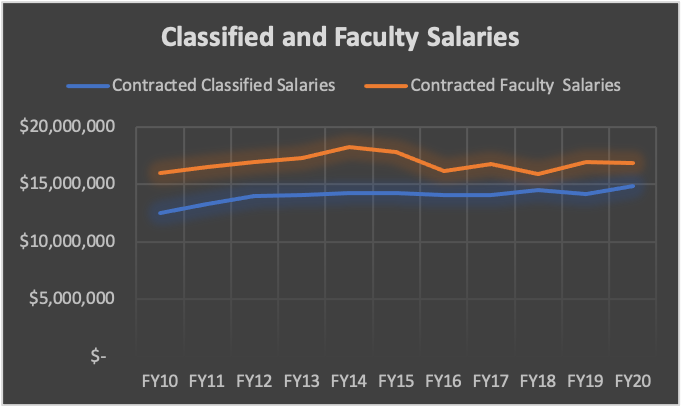
In addition, despite discourse to the contrary, total expenditures on faculty and classified staff salaries at the aggregate have remained relatively stable over the past ten years, with expenditures for contracted faculty salaries increasing only 5.8% from $15,968,615 in FY10 to $16,900,151 in FY20. See graph below and source data at: https://www.lanecc.edu/sites/default/files/budget/personnel_trends_and_ratios_detailed.pdf

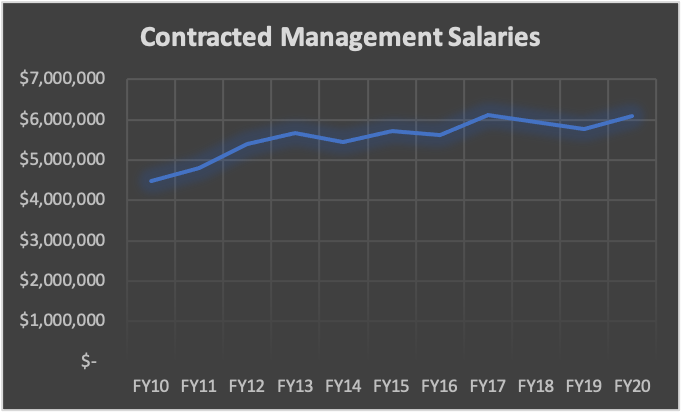
However, over the same ten-year period, total expenditures management salaries at the aggregate increased 36% from $4,475,500 to $6,084,467.

Please note that these data only include positions within Funds I and IX. Numerous non-faculty positions are accounted for outside of these two funds. For instance, while the FY20 management salary figures above account for 61.0 management positions, there were actually 71 management positions in FY20 when accounting for all funds within the college budget – 10 additional positions outside of funds I and IX. (See these details and position trends noted on p. 77 of the official audit statement at: https://go.boarddocs.com/or/lanecc/Board.nsf/files/BXFUE97BA98E/$file/Lane%20CC%20CAFR%206-30-20.pdf ) Furthermore, data provided by HR via a formal information request indicate that management FTE has increased again – – to 72.5 this year (FY21). Thus, the disparities only increase when including all funds within the college budget.

On balance, there is certainly some systemic pressure on the budget due to college spending priorities that are misaligned with the college mission, but the overall budget outlook is far better than expected given the circumstances and dire projections that have not come to fruition in the Governor’s budget and the overwhelming support provided by the federal government.

Oregon Legislative Update

In addition to lobbying for funding and statewide part-time healthcare, OEA is engaged in advocacy around a number of bills affecting community colleges or higher education more broadly within Oregon. These include: legislation to increase full-time faculty positions at community colleges, a bill to require part-time faculty pay parity, as well as voting rights for the student, staff, and faculty representatives serving on the HECC (Higher Education Coordinating Commission), among others. These include House Bills 2873, 2876, 2988, 3007 as well as Senate Bills 551 and 712, all of which can be tracked at: https://olis.oregonlegislature.gov/liz/2021R1

Faculty members, Cybele Higgins, Christina Howard, and I attended a meeting with local legislators this weekend to advocate for community college funding and healthcare for part-time faculty statewide. Your LCCEA and OEA representatives will continue to be engaged in this work throughout the legislative session.

Fireside Chat with Dr. Anthony Fauci, Thursday, 1/28, 3p.m. PST

LCC faculty are cordially invited to attend a virtual fireside chat with infectious disease expert, Dr. Anthony Fauci. The “chat” is sponsored by our national union, the NEA, and offers an opportunity for educators to ask COVID-19 questions. If you are interested in attending, please RSVP in advance and be sure to submit your questions for Dr. Fauci when you complete the registration form at: https://www.mobilize.us/nea/event/373215/?utm_source=NEAinhouse

RIF list update

A reminder to contracted faculty – please review your RIF lists that were issued Jan 13, and if you find errors, please complete forms to request corrections by Feb 26. You will find the RIF review form at: https://www.lanecc.edu/sites/default/files/hr/documents/requestrif.pdf Once complete, please email the RIF review form to: your dean with CC to Sharon Daniel in HR at daniels@lanecc.edu and with CC to LCCEA at: lcceacontract@lanecc.edu .

This Moment in History

Finally, I hope you had a chance to celebrate the inauguration of President Biden and Vice President Harris and the optimism the new administration brings. After the insurrection at the Capitol on January 6, it is a critical moment to reaffirm the fundamental role of the community college in a vibrant democracy.

I hope you will pause to consider how together, as faculty at Lane Community College, we can collectively help ensure we fulfill our responsibility within larger society to mindfully educate students to think critically, to promote civic engagement, and to actively build a participatory and equitable community.

In closing, I share the following quotes from AAC&U. “The task of an education allied to democracy is not simply to help students gain knowledge and skills. It is also to assist students in forming the habits of heart and mind that liberate their thinking and equip them for, and dispose them to, the creation of a more just and inclusive society through civic involvement.” And as reported in Inside Higher Ed, from Lynn Pasquerella, AAC&U’s president, “if colleges and universities are to develop the ‘independent and critical thinkers necessary to ensure that democracy is more than a tyranny of numbers,’ they must affirm that a liberal education helps students … discern the truth, recognize and digest narratives, and promote ‘an understanding that the world is a collection of interdependent yet inequitable systems,’ among other aims.”

Thank you for the work you do today and every day.

My best,

Adrienne

* Due to capacity limitations since December 1, Lane County Public Health is not conducting contact tracing except for vulnerable populations, so it is possible some cases remain undiagnosed and/or the case counts are incomplete. (See: https://lanecounty.org/government/county_departments/health_and_human_services/public_health/2019_novel_coronavirus__c_o_v_i_d19/contact_tracing )

** ALS has been identified for possible restructuring or reorganization, which may equate to reduction or partial reduction.

LCCEA Mission

LCCEA engages in collective action to ensure an equitable learning and working environment and advocates for social justice and systemic change for the public good. (Adopted March 2020)

Posted in General | Leave a comment