LCCEA President Updates on community college funding, bargaining, PERS, college budget, and more

LCC Faculty Colleagues,
I’m writing with updates on community college funding, bargaining, PERS, college budget, and more.
Community College Funding — Good News!
Today the legislature released amendments for HB5024 setting proposed funding levels for higher education in Oregon. The changes include an increased allocation to community colleges set at $640.9+ million. This represents an 8.5% increase over the $590M figure under consideration earlier this spring and a 12.3% increase over the $570M that community colleges received for 2017-2019.
This means that Lane Community College is slated to receive approximately $2 million more per year than projected.
Part-time faculty health care and LCC budget
Substantial momentum continues to build around SB 852. In addition to providing healthcare to part-time faculty throughout the state, the vast majority of whom receive no medical benefits, the bill would mitigate pressure on the LCC budget with a positive impact of $1 to $1.4 million per year because Lane is one of the three community colleges in Oregon where part-time faculty receive healthcare. In addition to a higher ed coalition of OEA, AAUP, AFT-O, and SEIU, thank you to our student leaders of ASLCC and OSA for supporting this bill as well!
PERS
The state Senate and House have passed SB 1049, which would divert a percentage of future contributions to retirement funds from all public employees’ individual accounts (IAP) to a separate fund in order to reduce the unfunded actuarial liability (UAL) that developed after the economic recession. OEA has been active in statewide efforts, in collaboration with other public employee unions and progressive organizations, to prevent this bill from passing. Other alternatives to address PERS are possible. See below:
If the governor does sign this reform into law, it is likely that it will be challenged in court. In the meantime, local bargaining teams for public employees statewide, including your LCCEA team, will be negotiating over the impacts of the law (should it go into effect).
College budget decisions
As a follow up to both the annual budget process and recent email conversations, please see graphs here: Contracted Employees Fifteen Year Comparison . It outlines some of the personnel trends and other factors impacting the college budget. For example, note that since 2005, contracted faculty positions have decreased by nearly one third; contracted classified staff positions have decreased by 30%, yet manager positions have increased by more than 9%. Also note the significant losses from the college-owned Titan Court apartment complex here: LossesfromProgramsAndTitan Court. Those losses total nearly $2.4 Million over the past three years, far exceeding losses from Food Services and the Bookstore, which are being outsourced, as well as some program and service cuts from 2017 affecting faculty.
While it is not possible to reverse some of the decisions from that past that have negatively and dramatically impacted the budget and services to students, it is certainly possible to make better decisions going forward. This includes filling positions on the basis of alignment with the college mission as well as via a college-wide staffing and needs analysis of all employee groups in all budget funds.
Email Communication
A reminder from last Fall regarding faculty discussions of controversial issues or expression of divergent viewpoints, the faculty contract protects these most precious gems — academic and professional freedom — the fundamental tenets upon which higher education and its goals are based. In addition, the contract protects the rights of the Association and faculty members to communicate via the faculty email list about Association matters.
Bargaining
The College continues to maintain a $0 offer to faculty. We hear that the College respects faculty and wishes to create a culture of support, and we hear that our College leaders recognize the central role that faculty play in the mission of the college.
Now is the time for the College to act affirmatively to demonstrate support for the work that we do in service of students.
With next year’s budget already balanced in early April and now news of an additional $2 million dollars per year for LCC from the state, it is clear that the college can afford to invest in faculty and faculty salaries. Hiring trends and decisions for vacant positions show that less than 58.5% of full-time faculty positions for next year will be filled, contributing to an overall decrease in full-time positions of more than 20% in five years and an additional decrease of 3-4% next year. At the same time, the college continues to hire new part-time faculty without living wage salaries. And Faculty Professional Development funding has dropped so much that conference funding ran out in Winter term this year.
With only one bargaining session remaining this term and our contract set to expire on June 30, it is time for the college to allocate funding in a manner consistent with the college mission in order to truly create a culture of support.
If you care about moving toward pay equity for part-time faculty, maintaining full-time positions, providing sufficient funding for professional development, maintaining reasonable workloads and reasonable cost of living adjustments and steps, please share your story at: bit.ly/FacultyStories. In addition, in order to support bargaining efforts, please fill out this two-minute LCCEA survey: http://bit.ly/TwoMinSurvey

Workload
You may recall from LCCEA reports in Fall that the College and Association were meeting again to complete the work of the Joint Workload Taskforce, as required by contract. The 2014 agreement allowed an increase in class sizes by up to four students in the majority of sections campus-wide. According to the College, this class size increase would produce $2 Million in net savings every year.
The Taskforce approached this work with renewed energy in October; however, the work has been stalled due to recent meeting cancellations by the College.
At the same time, the College has made a proposal in bargaining that would circumvent the Taskforce’s work and dramatically increase workload for faculty in the Arts, Cooperative Education, and Social Science as well as potentially throughout the college through the removal of all reference to class sizes. Not only would such a change dramatically impact workload for all faculty and reduce our ability to serve students in the classroom, it also would reduce the number of sections available to part-time faculty.
Your LCCEA Bargaining Team rejected the proposal, and your LCCEA representatives on the Joint Workload Taskforce scheduled two additional meetings (June 11 and 17) for the purpose of codifying assignable class sizes as required by contract.
As faculty, we continue to do our part in fulfilling the contract, taking on increased class sizes. It is our expectation that the College fully honor the binding written agreement and do its part as well.
A final note and thank you
The legislature’s substantial new investment in higher education did not happen in isolation. Community colleges will receive $70M more in funding because of the coordinated efforts of many — both at the state and local levels — including the OEA and the LCCEA with the support of the NEA, working together with students of ASLCC and OSA and collaboratively with staff and the AFT-O as well as administrators and Board members who have come together for unprecedented, unified advocacy this year.
This increased funding is a result of our collective efforts: at the President’s Day rally in Salem, in legislators’ offices, at town hall meetings, at the May 8 rally on campus and online, through letter writing campaigns, and testimony in Salem, to which so many faculty members from Lane have contributed, standing together with our colleagues in K-12 and beyond.
At the beginning of this year, the LCCEA – like public employee unions across the state and nation – faced the challenge of the U.S. Supreme Court’s Janus decision. As a faculty we reaffirmed our commitment to collective bargaining and the rights and benefits that unions bring to our members. With a resounding and definitive response, the faculty affirmed our membership, which has continued to grow steadily since Fall, with more than 480 active members now.
Being a union member is not only about our individual rights and benefits, it is about supporting the conditions that allow us to do our best work. And importantly, it is about ensuring that public institutions and critical services have sufficient funding to meet community needs.
As public employees we contribute to the common good. As faculty, we work every day to support our community college mission of access and social justice. We support the fundamental role of the community college institution in a healthy democracy. We provide an opportunity for higher education and social mobility that would not otherwise be possible.
We have advocated for the funding our colleges, our programs, and our students need.
And we have been successful.
And in so doing we have also demonstrated that the future viability of the public sector and public employee unions are inextricably linked. Our students and our communities depend on us. Our union helps ensure that we remain here to serve them and to serve them well.
Standing together with the 44,000 members of the OEA and with the support of the more than 3 million members of the NEA, we have made a substantial difference in future of public education in this state.
Thank you for everything that you have done to contribute to this effort and for all that you do as faculty every day!
My best,
Adrienne
Posted in General | Leave a comment

LCCEA OFFICER ELECTIONS

Elections for LCCEA Officers for 2019 – 2021 are now open.

The following nominations were received and accepted:

Vice President At-large: Russell Shitabata

Vice President for Learning Advancement: Wendy Simmons

Vice President for Part-Time Faculty: Nancy Wood

Vice President for Professional Technical Faculty: Christina Howard

Vice President for Transfer Credit: Lee Imonen

Treasurer: Marge Helzer

Voting is open through 5 p.m., Friday, June 7th, 2017.

To vote, you must use the link below, which is unique for each LCCEA member:

https://lccea.lanecc.edu/limesurvey/index.php?lang=en&sid=62879&token=ctzs7vaffq3r6tv

If you still have trouble voting, please email lccea@lanecc.edu


Posted in General | Leave a comment

May 8 Rally to Fund Our Future 11:45 am

thumbnail_IMG_5078
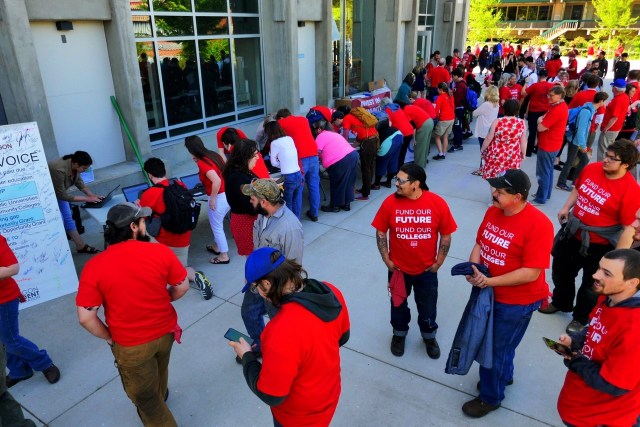
Join your LCCEA colleagues and all advocates of public education on Wednesday, May 8 for a “Fund Our Future” rally from 11:45 a.m. to 12:15 p.m. This event is part of a statewide day of action. The event will take place on the north side of the Center Building. At LCC in particular we will focus on community college funding and provide instructions for an easy way to contact Oregon legislators on your cell phone. Wear red if you can, but come even if you can’t, as red t-shirts should be available! Visit LCCEA’s table, which will be one of several.
As part of our ongoing efforts around bargaining, we again invite part-time and full-time faculty to share relevant stories on this form:
John Groves
————————————
John Groves
Part-time faculty, ALS & ESL
LCCEA organizing representative
Posted in General | Leave a comment

Bargaining Response and Update

Colleagues,
Due to faculty members’ overwhelming negative responses to the College’s bargaining proposal, the LCCEA Action Team will be contacting faculty members and department reps about various means to demonstrate solidarity and to support the LCCEA Bargaining Team. Please continue to send your feedback and keep an eye out for communications. If you wish to join the LCCEA Action Team, please email lccea@lanecc.edu
In the meantime, all faculty members are invited to share their stories about: the challenges of working as a part-time faculty member, the impacts of compensation inequities, the effects of the continued reduction of contracted positions, and the importance of the Faculty Professional Development program, as well as responses to the college’s proposal on the form at: https://forms.gle/fx36VbNzhsP1cU8r5
In addition, LCCEA department reps who have not yet completed the department rep survey are asked to do so at: https://forms.gle/vhdJP8c5biZjpnYc8
Finally, additional information about the May 8 Statewide Day of Action will be forthcoming, including details about a campus-wide rally in Bristow Square focused on advocacy for state funding for community colleges from 11:45 a.m. – 12:15 p.m. Please save the date!
Your Association
Posted in General | Leave a comment

President’s Update 4/17/19

LCC Faculty Colleagues,

I’m writing with more updates on bargaining, college budget, and statewide legislative issues.

Bargaining:

If you have not done so, please read the bargaining update provided by your LCCEA Bargaining Team last week. The LCCEA presented extensive data including:

  • the erosion of faculty salaries,
  • the inadequate compensation of part-time faculty causing some to be eligible for food stamps even while working half-time
  • the significant recent decrease in contracted faculty positions.

The LCCEA proposal would make substantial strides toward pay equity for part-time faculty as well as establish a threshold for contracted faculty positions.

The College presented an offer of $0 / 0% salary schedule increase (COLA) and zero steps for all faculty (a step “freeze”).

This is the worst offer the college has provided to the faculty in the forty-four year history of the LCCEA.

Please keep your eyes peeled for additional information from the Action Team, LCCEA Organizer John Groves, and your department rep(s) as we work toward a reasonable agreement with the college. In the meantime, please share your stories about how working part-time has impacted you or your students and/or how not filling vacant full-time positions has impacted you, your program, or your department at: https://forms.gle/Ey1io5hC197ENZDV8

LCC Budget:

While there was a significant projected deficit for next year, there is now a balanced budget proposal ready for Board of Education and Budget Committee approval. The Board voted last Thursday to outsource the campus bookstore and on April 1 to increase tuition, after an earlier vote to outsource Food Services as well. These changes will undoubtedly impact the campus community and especially students and staff. On a positive note, college administrators have made a commitment to involve faculty leaders in the evaluation of any proposed contract with Barnes and Noble in order to ensure that such a contract protects academic freedom as well as free, unfettered use of OERs.

Despite the substantial deficit that had been projected for next year, there are a number of factors impacting the budget positively.  State funding is up slightly; tuition will be generate more revenue, and the projected deficit included $6.4 million in vacant positions as well as other expenses that had been carried over (e.g major maintenance funding) at levels exceeding regular allocations. In addition, enrollment has improved and is also much better relative to other mid-sized / large community colleges in the state, which will positively affect Lane’s percentage of the state allocation. All these factors combined portend a budget that is objectively better than many recent years.

The key to fiscal sustainability at LCC depends not only on state funding but also on reforming college budgeting practices and ensuring that allocations and expenditures align with the mission and the primary purpose of LCC as an institution of higher education.

Better choices are possible.

For instance, some pressure on the college budget stems from the college-owned Titan Court apartment building, which has expenses that exceed revenues by approximately $635K per year. That $635K net-loss is being paid out of the general fund this year. This reduces available funds for essential programs and student services. If the College continues with current practice by keeping the apartment complex, the annual payments will continue through 2036 in order to pay off the debt, which totals approximately $16M.

In addition, based on information provided to LCCEA, LCCCEF, and Management Steering Committee (MSC), it appears the College is now planning to fill 11 vacant or new manager positions, bringing the total up to 72 for next year. At the same time 13 full-time faculty positions are slated to be filled for a total of approximately 202, which will still result in a decrease in contracted positions for next year, continuing the recent practice of replacing contracted faculty vacancies by hiring new part-time members paid far less to teach the same classes.

The LCCEA has called for a college-wide staffing analysis of all employee groups from all funds in order to begin the process of aligning expenditures to the mission — to instruction and student services. Such an analysis and alignment of budget allocations with needs would preclude across-the-board cuts, which disparately impact some departments, especially instructional departments with growing enrollment. Share your voice in advocating for adding sections whenever classes are full and additional sections should be added — the college generally sets aside funding for sections based on demand, and your instructional deans can play an important role in accessing such funds. You will find here a list of additional strategies for fiscal sustainability that I presented to the Board of Education last week: Long-termStrategiesforSustainableBudget

Legislative and Statewide issues:

Community College Funding

While better choices are possible for the LCC budget, it is also true that additional funding is necessary from the state. When adjusted for inflation, state allocations for community colleges have remained stagnant and have placed additional burden on students to cover an increasing percentage of their educational costs.

There has been a significant push in advocacy for community college funding over the past two weeks, both locally and statewide. LCCEA has engaged Career Technical (CT) faculty in a letter-writing campaign to the governor and state legislators with a focus on increasing funding for the CCSF as well as advocacy for the $70M proposed for additional funding to expand CT programs at community colleges. Thank you to the many faculty who have participated, and a special thank you to Sharon Hagan and Christina Howard, who have shared their letters publicly. You can access them on the LCCEA website at: https://lccea.org/  In addition, LCCEA coordinated a statewide effort expanding the letter writing campaign to include community colleges throughout the state.

Read it in the Register Guard Today!
Finally, I had the great pleasure of collaborating with LCC’s student body President, Nick Keough, in writing an Op-Ed to advocate for CC funding — it was published in today’s Register-Guard, and you will find it at: https://www.registerguard.com/opinion/20190416/keough-and-mitchell-vital-community-colleges-forced-to-scale-back

PERS

You have likely read about Governor Brown’s proposed changes to PERS. She proposed that employees who are currently working and part of Tier 1 or 2 would have to dedicate 3% of earnings (after the first $20K) to a fund to offset the unfunded PERS balance for current retirees. This 3% would be diverted from individual retirement accounts to a separate fund for 14 years or until the time when the PERS system becomes fully funded. For OPSRP members (AKA Tier 3), the percentage diverted from individual accounts would be 1.5%. This proposal would certainly affect K-12. However, it is unclear at this time whether community college employees would be impacted. The governor made reference to a separate fund / similar system for public higher ed employees, but there are no details available as this would likely depend on any resulting legislation. Meanwhile, other legislators including Senate President Courtney and House Speaker Kotek have announced they are working on their own proposal.

The OEA has responded quickly and strongly to this potential change. In addition, NEA President Lily Eskelsen Garcia has spoken with the governor to advocate on behalf of Oregon educators, asking if the governor wishes to be the only one in the nation to propose reducing teacher compensation at a time when public educators nationwide are increasingly engaged in campaigns to increase direly needed funding for education.

You may wish to contact the governor to express support for community college funding or to share your opinion on proposed PERS reforms at: https://www.oregon.gov/gov/Pages/share-your-opinion.aspx

Part-time faculty insurance

Senate Bill 852, which would provide insurance to part-time faculty statewide through OEBB and would result in a net increase to the LCC budget of approximately $1 – $1.4M, has been moved by the Senate to the Ways and Means Committee with a “do pass” recommendation. OEA, in coalition with AFT-O, AAUP, and other higher education alliance members, has strongly advocated for this bill an will continue this important effort.

Community College Member Interests

OEA is currently conducting a statewide survey of community college members. Your input is important. In addition, LCCEA welcomes any feedback you may have regarding communications you receive from OEA.

Board of Education Endorsement

A reminder — there are several positions on the Board of Education up for election in May. LCCEA endorses Lisa Fragala, who has been advocating consistently for community college funding at the state level and who continues to ask critical questions on the Board to ensure that the college budget is developed on a rational basis. All supporters are invited to a canvassing event this Saturday at 10:30 a.m. at 224 E. 11th Ave.

Save the Date: Statewide Educator Day of Action May 8

Save the date for the statewide educator day of action! This will be an opportunity to publicly demonstrate the need for increased funding from the state.

Thank you for all that you do every day as faculty members at Lane.

My best,

Adrienne

Posted in General | Leave a comment